Showing posts with label Timely magick. Show all posts

Jan 28, 2016

Mamemaki ritual and the Setsubun folklore

     February is crawling upon us, this year having an extra day too. It’s a month when we celebrate the “Imbolc” or “Candlemas” , and it’s a month that is thought to precede the arrival of the spring, and announces it, in spiritual thought. Indeed, for those parts of the planet that are blessed with seasons ( lol ), it does mark a period of more fair, if a bit moody weather. It already “smells” like spring where I am. The Snowbells are probably out already too, and soon the Saffron flowers, Buttercups and Daisies will follow, if this weather keeps up.

    Therefore, it’s hardly a surprise that the many civilizations and cultures associate it with the arrival of the spring and the end of the “dark” part of the year. The day lengthens, and people divine weather by signs. Make Imbolc Maiden beds, and do rituals to chase away the bad luck, and misfortune and replace it with the good luck. In thoughts of some civilization, it’s pretty much the actual New Year’s celebration. A good example is the Setsubun, a day that marks the begging of the spring in Japan.

    Setsubun significance and rituals

    Setsubun is a religious and public holiday (although not a national holiday) in Japan, commemorating seasonal division, and the begging of the spring, modeling after “Tsuina” an older Chinese custom that influenced the Setsubun rituals and customs. [1]
Oni Demon face/mask is a popular
    tattoo  design, here with a blue face,
but equally often with red . Oni demons
are the ones being banished with
the Mamemaki ritual

    It’s celebrated on the 3rd or 4th   of the February, the day before the start of the spring, according to Lunar calendar of Japan. Some of the customs and celebrations date back to the 13th century [2]
    The festivities include dancing, singing, throwing roasted soy beans, money inside envelopes, candy, treats, glitter, and religious ritual intended to deter and banish evil spirits, and draw fortune. The last is associated with the belief that, much like in the case of the European Samhain, or Midsummer, the veils between the worlds are thin on this day. Another example of similar notion taking important part of the holiday lore,  is the Chinese ghost month, of the Hungry Ghost month . And the other important lore of the Setsubun is focused on drawing the fortune. Hence the rituals with throwing lucky and auspicious things, namely “fuku mame” ( lit. “lucky beans” ) , which are roasted soybeans, or in some parts of Japan peanuts, although the latter is much less frequently used. So in that sense, Setsubun in much of a New year type of spiritual time, and is ideal  for cutting ties with the misfortune, disease, and damaging, and replacing it with health, fortune and helpful.

      Traditional Sake with ginger is drank during this festival, and some of the roasted soybeans are eaten, traditionally the number of beans eaten corresponds the number of the age of person, or the number of the age of person plus one for luck. The bean throwing ritual, also known as “Mamemaki” can be performed in the temples, at the public ceremonies, or at homes in the family circle, or both. It’s customary for people to get together on this day and often the celebrities and sumo-wrestlers are invited to take part in public celebrations.

     Sardine heads for protection

     Sardine heads are a peculiar choice of an amulet, by Japanese people, hung on the doors alongside the branches of Holly, tied with a knotted rope on Setsubun, so that they deter the evil spirits from entering the premises. Sometimes soybean husks are hung alongside the fish head. In some more archaic rituals, the sardine heads, well dry, and old wood were burnt, and smoke was wafted to chase away the evil spirits, often accompanied by sounds of drums. Although archaic, these types of rituals are still practiced today in some parts. [3]
    
     The Mamemaki ritual

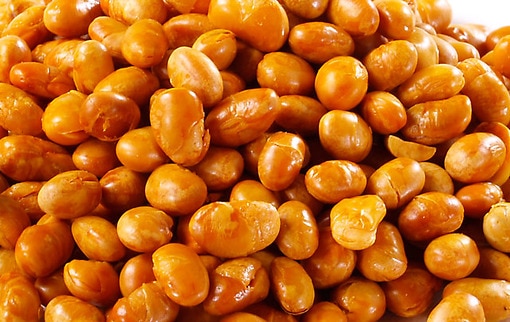
Roasted soybeans
as used in  the Mamemaki
ritual. They serve both for throwing
outside or on person wearing an Oni
mask, and to be eaten for attracting
the good fortune/luck
     This ritual is done, to repel the Oni demons, a blue or red-headed troll like creatures from Shintoism lore, believed to bring diseases, misfortune and other bad things to people. Reportedly, the soybeans, while raw hard, and pretty much inedible, by being processed by fire become edible and symbolize thus the conquering of hard, dangerous Oni demons. In that sense, the ritual of throwing and then eating the beans, is like the fire which softens them. Thrown at the demons, they are symbols of their defeat. So there’s a bit of   sympathetic magick in the rite. Also, all beans are considered lucky in Japanese folklore, hence the inclusion of such in a ritual that both repels and drives away evil.


      The  very ritual is typically described in the following manner:

“On Setsubun, each household loads up asakemasu, the wooden box in which sake is sometimes served, with roasted daizu, or soybeans. Then the head of the household (or a male in the household whose Chinese zodiac animal matches that particular year) throws handfuls of beans outside of the front entrance while chanting, “Oni wa soto, fuku wa uchi” (“Demons outside, good luck inside”).

Sometimes the rest of the household chants along, “Gomottomo, gomottomo” (“That’s right, that’s right”) as he performs this task; some, especially the kids, play the part of oni by donning paper masks and running from the bean-thrower. This ritual is called mamemaki, or the scattering of beans. Afterward, everyone eats the same number of roasted beans as their age for luck.” [4]

     So we see that the beans are thrown either around the houses, temples, or at the person/people wearing the Oni masks. The last is a typical roleplay ritual, not completely unlike those performed by Wiccans for example. Sometimes these beans are thrown vigorously through the open door, the phrases is spoken/yelled and then the doors are violently and swiftly shut close. This is a practice common for many spirit banishing spells, or spells and rituals that symbolize cutting ties with something bad.

     As an interesting side note; a somewhat comparable ritual with beans, was done during the Roman Saturnalia ( Sol Invictus ) , for the similar purpose, only that the ancient Romans were driving away the evil spirits of the dead, known as Larvae and Lemuri. Incidentally, or not, this was also a celebration which is similarly considered a New Year’s celebration festivity.

     Ehoumaki, the huge lucky sushi roll

     Another, more popular and urban tradition associated with the Setsubun holiday in Japan, is eating the fas sushi roll ( “futomaki” ) which contains 7 ingredients, on this day and it’s called “Ehoumaki” ( Ehou being pronounced much like the “echo” ) and must be ate facing a specific lucky direction.
     The ehoumaki may be purchased in the stores,  as they are readily available in time of the holiday but there are some requirements that must be met in order for it to work it’s lucky charm; it must contain seven ingredients, if possible ones reputed to be lucky, it must not ( under any circumstances ) be cut, and it must be ate in silence, facing a specific lucky direction which changes from year to year. [5]

Don’t forget that about Imbolc/Candlemas  and Valentine’s Day  , which are also in February.
Lots of love and many Blessings

Shadow


NOTES: This article was written and composed by myself, so If You wish to use any parts of it elsewhere online feel free, but do add credits; Shadow of the Shadows magick place, or  Shadow-333@hotmail.com or a direct link to this post

CREDITS AND REFERENCES:

[3] Acc. to the source listed under [2]
[4] Retrieved from: https://japanesemythology.wordpress.com/banishing-demons-one-bean-at-a-time/ for educational, informative and explanatory purposes, without any ill will
[5]  Acc. to http://justhungry.com/ehou-maki-lucky-long-sushi-roll-setsubun-no-hi , also recipes for ehoumaki provided there

Oni demon face/mask tattoo design   http://www.tattoobite.com/wp-content/uploads/2014/05/blue-oni-mask-and-waves-tattoo-design.jpg      Both used here for illustrative and explanatory purposes without any ill will

Apr 28, 2015

The power and symbolism of the Red Egg, and Paschal origins and mysteries


     As I am writing this the Easter, according to Orthodox Christian denominations that follow the Julian calendar ( old ) approaches. In fact,  the Easter is tomorrow ( 12th April 2015th ). 

     So I decided to write a little something about the tradition of dying/coloring  eggs, in Christian tradition, and hopefully to help dispel that silly, urban myth;  how it’s a Pagan tradition. Not because I have anything against Pagans, for the record; I have Pagan friends, but because I loathe the New- Age trend of watering down the tradition, and mixing up and confusing facts. On top of all New Agers and Neo-pagans then proceed to insist how it’s The (!!!) Truth, when in fact is just their own misinterpretation. In a very belligerent, and I must add spamming fashion, parroting their nonsense ad nauseum, in hope that a thousand times repeated lie will become just like the truth.
     One of the bluntest examples is related to the tradition of egg dying around Easter. Claiming that it’s related to old Germanic deity Eostre, or Ostara and Spring Equinox, they are in fact trying to appropriate, and claim authorship over such archetypical symbols such as spring, egg, rebirth, red color etc. It’s beyond reductive, absurd, and unfounded.

     Egg symbolism, and dying eggs traditions

     First off, egg is not a Pagan symbol, because as a symbol, it predates any organized religion. Monotheistic and polytheistic. Dyed eggs have been found in prehistorical graves, alluding most likely to early perception even among the prehistoric human, of egg, as a symbol of life, and vitality.
     The unearthed shells were often dyed with either red ochre, or blood, in the territory of what it’s now modern Ukraine, for example. [1]
     Eggs have reportedly been decorated ( usually Ostrich eggs  ) in Africa since the dawn of human, there.
     Egyptians have been dying eggs, mostly for use in their funerary rites, as early as 5000 years BC.
     Zoroastrian religious people have dyed eggs, on their New Year, Nowruz, which falls around Spring Equinox [2]  . Another practice of egg dying that predates Eostre cult. In fact, it’s noteworthy to mention that the first written records about Eostre, date back to the eight century AC ( Bede ) [3] while the Christians have been celebrating the Easter as early as from the 2nd century AC. Hence, all the, extremely spurious symbolism and egg myths associated with Eostre, at least in written records form, came much later.
     To sum up, symbolism of the egg is universal, so the egg is no more pagan in origin than the wheel or fire.
     Egg is a universal symbol of creation, sometimes the thing from which the life emerged; vegetative, Divine, or chthonic. Worldwide, it’s a symbol of affection, happiness, opulence, health, birth and resurrection.  It’s also associated with the springtime. In the Hebrew tradition, it’s a symbol of promise. [4]
     Finally, it’s also a symbol of Cosmic Egg, or Brahamanda ( in Vedic mythology ) and Orphis egg ( in Greek mythology ), from which, respectively, the very universe hatched and expanded, or the primordial, hermaphroditic  deity had.
     Ovoid shape, the egg shape, is a traditional shape used in occultism and talismanic to represent Akasha, the Ether, or the fifth element which is the Spirit. [5]
    
The Term misconception

     The only thing that, albeit very loosely, correlates celebration of Christian Easter with Eostre is the name.  And that’s only the case in Anglo-Saxon and Germanic counties and diaspora (!!). In fact, Christians will often use the term “Pascha” instead, or “Feast of the Resurrection of the Lord”.
     However to the many English speakers, Easter is a mundane word, with no connotation to Pagan’s month name, or fertility festivities;
“Some Orthodox Christians discourage the use of the word Easter, believing that the term has roots in pagan rites of the spring equinox and overtones of fertility. Most English speakers are unaware of the etymological origins of Easter, however, and use it without any sense of pagan connotations, and so Easter is also used by many Orthodox English speakers.
The origin of the term Easter comes from the Germanic name for the month in which the Christian feast usually fell, and so, just as the American civic holiday of the Fourth of July has nothing to do with Julius Caesar for whom July was named, neither does Easter have anything to do with the pagan goddess Eostre, the namesake of the month in which Pascha fell. “ [6]

     Christian symbolism of the Egg
   
     For the Christians, egg has additional symbolism, aside the universal attributes. It symbolizes and empty tomb, or the tomb of Lord Jesus, whereby the hard, shell exterior symbolizes the stone which was used to cover the entrance to the Christ’s gravesite. Breaking the eggs on Pascha symbolically represents breaking off the stone on Christ’s grave, and just as the little chicken hatches from the egg, so does a new life, Christ rises from grave, defeating thus death. Hence to the Christians, egg is not merely some fertility symbol, nor is associated with the rabbits, those are things of popular culture, and commercialism.
    Traditionally Christians would abstain from eating meat (least the fish on certain days), eggs, milk, or any animal byproducts during the Lent period ( 40 days prior to Pascha ), and the eggs were thus something that was tabooed during the period, in order   to stress out the Divine symbolism embodied in them. This is still a living tradition among Eastern Orthodox Christians, as well as some Eastern Catholic Christians. [7] Hence, the first thing the pious taste, after the communion that is, on the Pascha is an hardboiled egg. Not the chocolate one lol.  
     Christians have been dying eggs in Europe from the XII century, and in Slavic countries ever since the XVI century, which was done to commemorate the miraculous and joyful resurrection of our Lord Christ, who thus saved human souls from perdition, and ensured them eternal life. This is why, the eggs are traditionally dyed in red color, even though in modern times, eggs are being dyed all sort of colors or even decorated with intricate, and meticulously created art, such as is the case of Ukrainian “pysanky” or “pisanki”.
     The oldest technique for this complex method of art decorations    is so called “batik” technique where the special tool, having a quill top pen attached to it, was used to    dispense the melted beeswax over the eggshell, creating decorative, and symbolic patterns, ranging from phytmorphic, over eternity knots to Christian symbolism and inscriptions, such as the Paschal Christian greeting: “God has risen!!!” [8]
    But the red dyed eggs still remain the most favorable, and most traditional kind for Christians. The red color on them symbolizes Blood shed by Lord Christ, life, resurrection, and vitality, also rebirth and health. The first egg dyed red, during particular Paschal season, usually whole red, or decorated with a Cross, or words “God has risen!”  is set aside and kept in home during  the  whole ( following ) year, as a powerful talisman to protect the house from lighting, thieves, misfortune, sickness and epidemics and evil spirits and spells. In Serbia and Montenegro, such eggs is referred to as “Cuvarkuca” (lit. House-guardian), and is kept in some special place in home, often on display, to protect it. After a year has passed, it’s either buried in the ground, or tossed into a running water, and then replaced by a new one. [9]     
     Eggs dyed red are also associated with the miraculous event associated with Mary Magdalene that took place when the Christ resurrected according to Christian legend. The Legend comes in a few variations, in one of them Mary Magdalene came to the tomb of Christ on the third day   after the Crucifixion, only to find and empty tomb. Upon seeing the risen Christ, the eggs she was carrying in basket turned red.
    “A different, but not necessarily conflicting legend concerns Mary Magdalene's efforts to spread the Gospel. According to this tradition, after the Ascension of Jesus, Mary went to the Emperor of Rome and greeted him with "Christ has risen," whereupon he pointed to an egg on his table and stated, "Christ has no more risen than that egg is red."
After making this statement it is said the egg immediately turned blood red” [10]
    In a third legend Mary Magdalene  encounters some Roman soldiers, and greets them with “Christ has risen!” to which they mockingly replay that Christ is risen as much as eggs are red, which results in rain of red eggs falling down on them, striking them with awe and terror, in front of the revelation.

     The power of the red egg, folklore and beliefs among the Christian folk

     Following are some beliefs associated with the Paschal dyed egges, particularly red ones, prevalent among the pious Christian folk

·         The First egg boiled and dyed red for Pascha is set aside to guard home from thunder, thieves,  evil spirits, spells, and misery and illness  ( Serbia and Montenegro, Peninsula ) Several “pisanki” are   saved for the same purpose in Ukraine and Russia
·         The same egg is dipped inside a vessel with water and freshly plucked flowers, blossom and Rosemary twigs, on Palm Sunday, overnight. The next day, the household members, and children wash their face with this water to ensure health, beauty and longevity.
·         Among the Czech and Slovak people, young men hit young women ( lightly ) with birch or willow twigs, and sprinkle them with water, and in return the girls give them red dyed eggs. This is said to confer to the girls beauty and good   health.
·         In Germany and England people dance around hard boiled, dyed eggs on Easter, taking care not to break them. This is sometimes referred to as Egg-dance, or hop-dance in England.
·         Pysanky or pisanki, with spiral motifs can be used to trap demons. A blessed Pysanky can be used to find demons hiding in dark corners of someone’s house ( Ukraine )
·         Cloth that was used ( or a napkin ) first dyed egg on Pascha ( in Balkans ), or the “Cuvarkuca” ( in Serbia and Montenegro ), or  the first “pysanky” in Ukraine, was believed to retain healing powers for the  time of year, and was used in healing rituals.
Benediction of the eggs
     The Paschal, or the Easter eggs, are traditionally blessed by Christian priest, in Eastern Orthodox Christianity, and are then exchanged among the pious, and given as alms to the poor, believing to bring blessings and health when eaten.
     In Serbia and Montenegro, an old European custom survives, and  lives even nowadays, and consists of egg  knocking contest, where the two parties knock eggs, which will result in one being broken and other remaining whole. The owner of the “whole” egg is considered a winner, and also gets the other party’s broken   egg, as a  reward, and moves on  onto the next opponent, doing so as long as his egg remains whole.
     In any case, eggs, most often chicken, boiled and blessed on Pasha, or the  Feast of the resurrection of the Lord are held in belief as powerful blessing and healing tool, as long as You don’t eat too much that is J That would merely give one   a stomachache  and possibly constipation J
    Here is an old prayer, fro the Latin Rite Romanum, used to benedict the  Easter eggs:


“Lord, let the grace of your blessing + come upon these eggs, that they be healthful food for your faithful who eat them in thanksgiving for the resurrection of our Lord Jesus Christ, who lives and reigns with you forever and ever! “ [11]


NOTES: This article was written/created by myself, so If You wish to use any part of it  elsewhere online, feel free but  add credits: Shadow of Shadows magick place , Shadow-333@hotmail.com or a direct link to this post

CREDITS AND REFERENCES:  
[1] more about Ukranian tradition of dying and decorating eggs ; http://www.encyclopediaofukraine.com/display.asp?linkpath=pages%5CE%5CA%5CEasteregg.htm
[4] According to “Illustrated Encyclopedia of signs and symbols” by Marc O’ Connell and Raje Airey
[5] As stated in: “How to make and use talismans”   by Israel Regardie
[6] Quoted from: http://orthodoxwiki.org/Pascha  ,  used here for educational and explanatory purposes without any ill  will
[9] According to  Dr. Vesna Marjanovic, from the Ethnographic museum of Belgrade; more here:  http://www.blic.rs/Vesti/Dodatak/183594/Jaje-je-simbol-zivota translated and paraphrased here by myself, for educational ,  explanatory and discussion  purposes, without any ill will
[10] Retrieved from:  http://en.wikipedia.org/wiki/Easter_egg , used here for educational and explanatory    purposes without    any ill will
[11] Retrieved from   same source   listed under [10]  , for educational and illustrative purposes, posted here without any ill will

IMAGE CREDITS: Image used was taken, and edited by myself

Feb 8, 2015

Magick potions for Valentine's day


"I'm Living for love
Not gonna stop
Love's gonna lift me up"

Madonna "Living for Love"

     Do you have Your Valentine already, or are you about to find one? For If You do not, keep in mind that the love is a far more complex concept than having someone on that one particular day, s which is a commercial holiday, anyway. And it’s neither bad luck, nor lame to not have a romantic partner on Valentine. Insipid people will say, that anyone supporting such viewpoint, does it only because they themselves have no Valentine. Absolute nonsense. Not only that It’s logical fallacy (correlation and causation), but it’s plainly incorrect, as many happy couples do not celebrate Valentine day, but rather chose to show love to each as often as possible.

     
     I have written about the dubious history behind the “chocolates and roses holiday” on this blog before (and let me tell you it’s murky and vague loll).  I have also written about many “love conjurations”   that can be used, should you be so desperate to feel that you absolutely need someone else, on Valentines, to justify your own existence.

     But there are some nice things about the holiday as well, such as Valentine’s folklore andlove divination. And the fact that If You truly see it as holiday   celebrating love, try to expand Your concept, and broaden your understanding of love, further from romantic love,  to philanthropic love, caring and humanism. Heavens know we lack those, badly, these days.

     In any case, following are some love potions, or “philtre” formulas, which I composed for posting here, as a small tribute to my readers, as well as to illustrate at least three aspects through which romantic love can be seen. The lust philtre illustrates, that "down to earth", not to say profane, “love”, the potion to heal the broken heart, illustrates misguided, and hurtful, non-productive infatuation, and gives a solution to it, while the third potion illustrates, gentle romantic love, or even philanthropic love and is a formula used to draw it.
     Hope these will be of use to you. Happy Valentine, and lots of LUV to You. J


Lust “philtre”

     Take some Coriander seeds, and beat them in mortar and pestle, or in a bowl with the knife’s handle, while calling the name of the one you desire to feel lust towards you. Heat some red wine and pour it over the seeds. Let it sit for about an hour then strain.
     Next, put the water to the stove, and as you wait for it to boil, mix some Hibiscus tea, Damiana seeds, and few Juniper berries. Beat them up, like you did with Coriander seeds, and call the name of the one you wish to feel lust towards you as You do it. You can envision them being stricken with lust and infatuated with you, while doing it. When the water has started to boil, add the herbs to the water, remove from heat, cover and let sit for about 20 minutes, than strain.
     Mix the wine and the herb infusion, and add to it; a single teaspoon of Carrot juice. If you want to “disguise” the potion as a glass of wine, add much more vine than tea infusion, and vice versa. You may sweeten it with honey. Traditionally, one would finish this by adding a drop of their own blood, from their ear. Also a pinch of Cinnamon can only benefit a potion like this, but is certainly entirely optional. 
     Then, give the potion a few final stirs, as You chant something along these lines:

“Magick essence of carnal desire,
Ignite in those that drink you lustful fire!”

     Prepare some Friday, during the Mars hour, or if You are in a hunrry prepare any day in the Venus hour.
      I do hope it’s redundant for me to say, that inducing lust in someone is a form of confusing and controlling them, and is thus hardly ethical. Also, this will probably not work on chaste people.

Potion to heal broken heart and love pains

     During the waning Moon phase, and day and hour of the Sun, combine the following:

·         * Water from the spring, preferably taken either prior to the Sunrise, or during it ( about 500ml )
·         * Rose hips, white and Red rose will work fine, about two teaspoons
·         * Violet leaves, a few
·         * Lemon balm ( Mellissa )  herb, a teaspoon
·        *  Heartsease herb, a teaspoon
·         * Horehound
·         * OPTIONALY: pinch of Marjoram
·         * Some honey to sweeten it up

     If it is warm enough, place the herbs in a transparent glass container, pour the water over them, and let them sit for 6-12 hours, If possible in direct sunlight, stirring occasionally. If You are using this method, You can also add any of the following crystals to the water: Rosequartz, Watermelon tourmaline, or Green Aventurine.
If not, pour the boiling water over the plants, cover, and let it sit for about 30 minutes. Then stir a few times.
As you stir, you can chant something along the lines of this:

“Injured heart that aches in pain
Love has hurt, and left without gain
Cleanse it from the love that should not be
Restore it, heal it, and from pain set it free”

     Strain, sweeten with honey and drink, in three partitions, on each 9 hours ( refrigerate if You wish ).

Potion to draw positive love
     
Mix the following:

·        *  Rosewater, preferably one You made Yourself
·        *  Lemon balm tincture
·       *   Lovage tincture or, a few drops of essential oil
·       *  A tablespoon of Rose Quartz essence

     Mix the ingredients, just mind that If you are to bottle and use it for longer period of time, or keep it, the alcoholic content ( tinctures mixture, or tincture with few drops of essential oil ) should make up for at least 70% of the potion, whereas Rosewater and Quartz essence should make up for 30% ( or less ) of the potion.
     Pour in a clean spray bottle, and shake a few times as You chant: 

Beneficientia, sympathia, at amor  leni
Mihi  cursim veni.

( “Kindness, sympathy and gentle love,
To me swiftly flow” )

     Spray on Yourself, like You would do with a perfume. You could also pour it in a nice glass bottle with a cap, or dropper and use it as cologne, applying a bit on Your neck, or hair, or even hands. 

So don't forget, don't  go trhough life seeking justification and confirmation through another, don't live for a or the partner, rather start Living for love ;) Happy Valentine, LUV ya all :) 
Shadow


NOTES: This article was written and composed by myself, so should You wish to use any parts of it elsewhere online feel free, but do add credits; Shadow of the Shadows magick place, Shadow-333@hotmail.com  , or a direct link to this post

IMAGE CREDITS: Images used are photos taken and edited by myself

Jan 30, 2015

The Light of the World, and Candlemas

"All the darkness in the world cannot extinguish the light of a single candle"

St. Franics of Assisi, "The little flowers of St. Francis of Assisi "


     On the 2nd of February, Catholic Christians, and some Orthodox Christians as well ( along with Copts and Armenian Christians  ) celebrate the holiday commemorating the presentation of the 40 days old infant Jesus, our Lord, to the temple and purification of the Virgin Mary.

Presentation of Infant Lord Jesus , at the Temple
with Simeon and Ana, the Light of the World


     The holiday has varying names, in different Christian denominations, and different parts of the world, such as :  “The presentation of Jesus at the Temple”,  “Meeting” ( Greek Orthodox Church, originally; “Hyapapante” ), “Feast of Purification of the Virgin”, or as commonly called among the pious; “Candlemas”.

     Among Eastern Orthodox churches that use Julian calendar, Candlemas, often called “Meeting”, or “The Meeting”  is celebrated on 15th of February ( according to Gregorian   calendar ).
     For Pagans, the whole 3 day period, between 31st of   January and 2nd February ( sunset ) is a sacred period, called Imboloc, orOmeilc   ,  celebrating the lengthening of the days, arrival of the spring and the  conception of their chief solar, male deity, by a  goddess Brigid. They customary   offer this goddess  with milk, or butter during these days, and make special beds, that they “dress” ( pour on them ) with milk and honey.
     Christians, similarly, on 1st of  February, celebrate the Saint Brigit ( or St. Brigid, sometimes ) of Ireland, a saint reportedly brought up by the druids, but who had, even as a child, feel drawn by Christianity, and reportedly, after hearing  St. Patrick’s sermons, got baptized herself. She founded a group of monasteries in Kildare, she was famed for her   profound spirituality, and devotion, as well as charity. Legends speak of many miracles performed by St. Brigit, from the miraculous spreading of her veil, over the enormous   partition of certain King’s land, to rendering apple trees infertile, or wondrously fruit-bearing double fruits.  Her patronage is over: blacksmiths, Ireland, workers in dairy industry, babies, farmers, poor and needy,  children whose parents are not married, scholars, to name a few.
    
     The Holy Light of the world

     Candlemas, commemorates the presentation of the baby Christ, in the temple, as well as purification of the Virgin Mary, 40 days after the birth. This was a custom, or rather a ritual law, according to Mosaic laws, given to people by G’d over the prophet Messiah. According to Mosaic law, a mother who had given birth  to a “man-child”  was deemed unclean  for 7 days, and had to remain ( after these 7 days ), “in the blood of her purification” for the next 3 and 30 days ( so 33, plus 7, 40 altogether ). In given time period, the new mother, was forbidden  to  step foot in sanctuary,  or even touch holy things. After the given time period, she was to present her child in a temple, bringing with her, an offering, to be prayed over by the priest, in form of young ( one year old ) lamb; “for the holocaust”, and a “young pigeon or turtle  dove for sin”. If the mother was unable to provide a lamb,  the two pigeons or turtle doves, were used instead. Having the priest pray over these “sacrifices” the mother was rendered pure again. [1]
     In case of The most Holy Theotokos ( Virgin Mary ), and Jesus, the son of Lord, fulfillment of these laws was not needed, for the Virgin was pure ( regardless of what protestants try to argue, pointlessly I must add ), and the Lord knew His Only Son,  but  the Virgin and her Son, the Savior, have fulfilled the Mosaic law requirements regardless.
    St. Simeon the righteous, prayed over offerings of Virgin Mary, and then proceeded to relay to her a prophecy, about the destiny of Her Son, the Savior, as well as the sorrow she will feel one day for losing him. In the temple, at this point was also the Prophetess Ana, who immediately started offering prayers and praise to Lord for  Jesus, and speaking to everyone  about Jesus and his role in the  salvation and redemption of Israel.
    The scripture describes the event this way:

“34And Simeon blessed them and said to Mary His mother, “Behold, this Child is appointed for the fall and rise of many in Israel, and for a sign to be opposed— 35and a sword will pierce even your own soul—to the end that thoughts from many hearts may be revealed.”
      36And there was a prophetess, Anna the daughter of Phanuel, of the tribe of Asher. She was advanced in years and had lived with her husband seven years after her marriage, 37and then as a widow to the age of eighty-four. She never left the temple, serving night and day with fastings and prayers. 38At that very moment she came up and began giving thanks to God, and continued to speak of Him to all those who were looking for the redemption of Jerusalem.” (Luke 2:34-38)  [2]

    Simeon, who had been promised that he will not see death, before he had seen the Savior of the human race, at that point, also said a prayer, which has later became known as “Nunc Dimmitis” ( or also, “The canticle of Simeon” ) and is as follows:
Latin:

“Nunc dimittis servum tuum, Domine, secundum verbum tuum in pace:
Quia viderunt oculi mei salutare tuum
Quod parasti ante faciem omnium populorum:
Lumen ad revelationem gentium, et gloriam plebis tuae Israel.”

English ( “Common worship” 2000. ):

“Now, Lord, you let your servant go in peace:
your word has been fulfilled.
My own eyes have seen the salvation
which you have prepared in the sight of every people;
A light to reveal you to the nations
and the glory of your people Israel.” [3]

     The same prayer is sung, as the blessed candles are distributed to the clergy and the pious, in the temple, during the Candlemas’ service ( mass ), by the choir.
     Adressing to the infant Jesus, as the light to the  revelation of Gentiles, Simeon affirmed that Lord Jesus, is The Light of the world, or the Holy Light of the world, of which we are reminded on Candlemas, and which is embodied in symbolism of blessed candles.
     This is also, why Candlemas, in Christianity, and Christian spiritual practices and  lore is a day of purification and illumination.

     Beliefs, lore and symbolism


     There are many beliefs associated with Candlemas, but some of the most beautiful and well recorded include those about the Blessed candles, Snowdrop flowers, and pancakes ( crepes ).


      Holy ( Blessed ) Candles

     It is a tradition to bless the candles, on Candlemas, both those from church and those brought from homes, by  the pious people, but it is required that the candles are made of beeswax.  This is really essential, being that it bears an important symbolism. Beeswax, created by bees, by collecting juices and nectar from the flowers, symbolized the  virginal, and pure flesh of the baby  Christ,  because he had not broken Virgin Mary’s purity, neither by conception, nor by birth. The candle’s flame, is symbolic of Light that illuminates the darkness of the world, which Lord Christ is. [4]
     According to the Saint Anslem of   Canterbury, there are three aspects of Blessed candle to observe, the wax, representing Lord Christ’s virginal body, the wick, representing His Soul , and the  flame, representing His Divinity. [5]
     The candles obtained at the mass on Candlemas, are considered particularly holy and powerful, and are this preserved by some   folk throughout the whole year (or as long as they last) and are lit in times of great need. Particularly when one needed to defend themselves from thunder, wolves or evil spirits. By merely lighting the wick, such candle was believed to dispel evil, banish and protect from storms and wolves, and all kind of enemies ( even humans ), or heal, but oftentimes,  the act of lighting and burning it was accompanied  by a prayer, such as the following:

“Jesus Christ a King of Glory has come in Peace.+ God became man, + and the Word was made flesh.+ Christ was born of a Virgin.+ Christ suffered.+ Christ was crucified.+ Christ died.+ Christ rose from the dead.+ Christ ascended into Heaven.+ Christ conquers.+ Christ reigns.+ Christ commands.+

May Christ protect us from all storms and lightning. + Christ went through their midst in Peace, + and the Word was made Flesh.+ Christ is with us with Mary.+ Flee you enemy spirits because the Lion of the Generation of Juda, the Root David, has won.+ Holy God! + Holy Powerful God! + Holy Immortal God! + Have mercy on us. Amen
.  [6]

    Sometimes people will even divide the candle ( cut ) in pieces, and burn the whole pieces when needed.
    While it’s not exactly the same, You could bless Your own beeswax candle, and If done on Candlemas, obtain a powerful tool of magick, at least for apotropaic work. You can bless it, as it’s suggested to be done in Solomon’s key ( The Greater key of King Solomon, or “Clavicula Solomonis” ). If You are going to make it though, You will be needing a virginal beeswax  , that is the wax that the bees had laid for their first time. Otherwise, You can purchase a waxen candle from the Christian church.
    Then You’d proceed with saying the specific conjuration, reading a set of Psalms ( around 17 Psalms, I think ) and, finally a prayer:

“ I exorcise thee, O creature of wax (or of Earth), that through the holy name of God and his holy angels thou receive blessing, so that thou mayest be sanctified and blessed, and obtain the virtue which we desire, through the most holy name of ADONAI. Amen “  [7]

    By sprinkling the candle ( or  was You are going to use to make it ), You’d be done, that is according to The Greater Key of Solomon. I’d also cense ( fumigate ) with incense, as that’s what the Christian priests do with  the Candlemas candles. In fact the candles are being fumigated as they pray, specific five prayers. The Catholic priests have set of 5 prayers they use to bless these candles.
    If then, You’d wish to dress this candle, You have made Yourself, You could dress it with “Essence of light” oil formula, I composed ( see the formula bellow in the text ).
    There is also a prayer used for blessing the candles by Catholic Christians, and it goes as follows:

“Lord  Jesus,
You are the Light of the world:
we praise You,
and ask You to guide our steps each day.
Help us to love You and serve You faithfully,
and to carry our daily cross with You.

Bless + this candle,
and let it always remind us
that You are our Light in darkness,
our Protector in danger,
and our saving Lord at all times.

Lord Jesus,
we praise You and give You glory,
for You are Lord for ever and ever.

Amen.”  
[8]

     I am not certain, however, should this particular prayer be used only by the clergy  ( priests ) like in the case of those used for  creation of the Holy water, but it’s certainly befitting to be added, as a part of Your consecration ritual.

     Crepes

     While in Mexico, tamales and chocolate sauce are traditional food for Candlemas, and are prepared by person who found the coin ( or whatever was placed inside ) in the King’s bread on the feast of Epiphany  , in Europe it’s commonly the Crepes.
     This has also due to the belief that they stand for abundance, prosperity and wealth. There is even a belief in Europe, You should make and stalk Crepes, as the Church bells are sounded on mass some Sunday in January to ensure the prosperity through the year.
     On Candlemas, this belief would be befitting too. Fill the first crepe You make with  some Honey, roll it up, read Psalm 23 over it, and then eat it, so that You will never be hungry, but instead prosperous  in  the  upcoming month of the year.
     I use this amazing recipe for crepes    found on BBC’s website , and they always turn out amazingly.

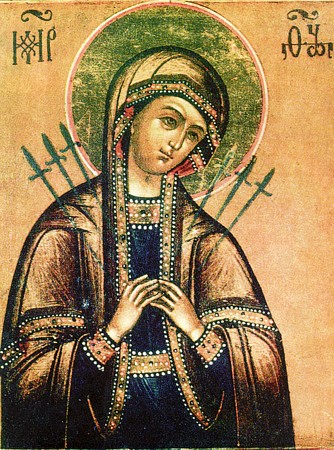
     Our Lady of Sorrows / Softener of the Evil Hearts

     Virgin Mary, is sometimes depicted with swords piercing her  heart, in accordance with St. Simeon’s prophecy. It’s reffered to as : “Our Lady of Sorrows” or “Our Lady who softens evil
Orthodox Christian icon, from Russia,
depicting Theotokos ( Virgin Mary )
with  swords piercing her heart; "Softener of
the evil hearts"
hearts”  ( in the Eastern Orthodox Christian   Church ).
     The latter, “Our Lady who softens evil hearts” , or “Softener of the evil hearts” or “Simeon’s prophecy”, is also the  Theotokos miraculous Russian icon, which is also commemorated  on the 2nd of February by Eastern Orthodox,  and some Eastern Catholics too.
     Among the Eastern Orthodox Christians, it’s customary to pray in front of it, to soften the hearts of our enemies, or even someone from whom we seek forgiveness, or even favors ( authority figures, teachers, bank clerks etc. ). Often the part
     If You wish to pray to the Mother Mary for such, in front of mentioned icon, light also a beeswax candle, and You can very lightly coat it with honey. Bellow it You can place a name paper with the name of the person whose  heart You wish softened, although this is not necessary. After a heartfelt prayer You may wish to add these words:
“Rejoice, much-sorrowing Mother of God, turn our sorrows into joy and soften the hearts of evil men!”

     Snowdrops or the “Candlemas bells”

     The Snowdrop flowers,  are traditional symbols of Candlemas, in Europe, as they represent  hope, light and purity. They often bloom on Candlemas, even though that some varieties can bloom earlier, later or the whole winter, as a matter of fact. They are mentioned in apocryphal Christian legend, which speaks of how Eve was frightened and devastated because of the snow, she had encountered after the banishment, but was comforted by Angel, who had miraculously made the Snowdrops appear, in some version from the snowflakes, comforting Eve thus.
     While Snowdrops  are bad luck to take in home before the  Candlemas, brought into home on Candlemas they will bring purification, illumination and luck to home, and banish evil from it.
     The poem  “Origin of  the Snowdrop”  ( by George Wilson ) illustrates nicely the beliefs about snowdrops:

"And catching, as he gently spake,

A flake of falling snow
He breathed on it, and bade it take,
A form, and bud and blow;
And ere the flake had reached the earth,
Eve smiled upon the beauteous birth,
That seemed, amid the general dearth
Of living things, a greater prize
Than all her flowers in Paradise.

…
And thus the snowdrop, like the bow
That spans the cloudy sky,
Becomes a symbol whence we know
That brighter days are nigh;
That circling seasons, in a race
That knows no lagging, lingering pace,
Shall each the other nimbly chase,
Till Time’s departing final day
Sweep snowdrops and the world away
"

Retrieved from http://www.perilousadventures.net/blog/?p=1453 , for illustrative and explanatory purposes

Essence of light oil

My own formulae, suitable for use as a devotional oil on Candlemas, and in any spiritual work associated with illumination, purification and uncrossing.
Combine:

·         * Angelica roots
·         * Rosemary branch
·        *  Frankincense tears
·         * Chamomile flowers
·         * Calendula/Marigold flower

All in base of Sunflower and Jojoba mixed oil. Jojoba alone, Sunflower alone, and even Almond oil will work just fine.


Hope this was informative and inspirational for You
If I don’t post anything before it… Have a Blessed Candlemas
With luv… Shadow J


NOTES: This article was written, and composed by myself. If You wish to use any part of it elswhere online, feel free, but add  the  credits; Shadow of the Shadows magick place,  Shadow-333@hotmail.com or a direct link to  this  post 

CREDITS AND REFERENCES: 


[1] According to the Catholic Encyclopedia ( online ): http://www.newadvent.org/cathen/03245b.htm
[5] According to: “The Liturgical year” by Prosper Pascal Luis Gueranger (   abbot of Solesmes )
[6] Prayer retrieved from  the source listed under [4] , for educational, and illustrative purposes,no ill will
[7] Retrieved from: “They key of Solomon” S.L. MacGregor Mathers’ edition


Dec 28, 2014

Space cleansing tips , for a better year

    Small token of gratitude for you, because you read what i write ;) 
   
     It’s that transitive time of the year, once again.  The point in time, at which we all, despite its festive tone, feel the extra stress, and the extra burden. We long to release the ills and pains, misfortune and fails, and jump right on the success bandwagon. Should we fail, we easily fall into depressive mood and then self-pity ourselves in desperation.  The truth is, life is complicated and it rarely comes out all perfect just at the end of December, to conveniently make this transition pain-free and all “birds and bees” as it were.
Holly attracts  benevolent spirits to the house

    
     Once we fall prey to such, mass-produced and vulgarly perpetuated elusive and counterfeit notions, we can and will only harm ourselves, preventing the actual grow and success. It’s like the notion, that If You don’t have a Valentine, on Valentine’s day, You are an epitome of failure.
   
     So rather than obsessing with where You will spend New Year, what to wear, and will You have someone to call “yours” on that particular eve, focus on harnessing the power of the moment.  Tune to the spiritual forces of new beginnings, blockbusting and road opening, hope, chances and opportunities. It’s not really that hard.   But to be successful in something, You ought to make sure that there are no things dragging You back, pulling You down, like rusty, heavy chains. Spiritual cleansing and clearing, is something people foolishly neglect, particularly at this time of year. You would not keep Your physical body grimy, filthy and unpleasantly smelling, but You are ok with all kind of spiritual debris, and impurity? I don’t think so. What You don’t see, can definitely harm You, and badly too. 
     
     In fact, many people who come to spiritual workers seeking uncrossing, need cleansing badly.  Spiritual filth accumulates, chocking Your subtle bodies, and deflecting the positive energy coming Your way. Likewise is with Your home or working place. Bad energy lingering around, equals bad productivity, and ultimately, frustration.
     
     Even If You don’t “have it all” this December, cleanse Yourself and Your home, and then You will have incomparably higher chances to attain what You desire. To accomplish your goals. To live prosperously, find a new lover, get a better job, move to a better place, get recognition and respect… You name it J
     
     This is the best (!!!) time of the year to not desperate, but instead deal away with, and cut ties with things, emotions, and conditions keeping us down. Here are a few tips.

Physical cleaning

     It may seem like common sense.   And it certainly should be, but why do majority of people then have problem of disposing of the things that not only have no  use anymore, but are maybe even horrid mementos to  the bad things that happened to us?  Prior to the New Year, do Your best to clean away the clutter in Your home, workplace, etc. As thoroughly as humanly possible. Dispose of the old, unnecessary thing that take space, and poke the eye.   If You have some clothes that You can’t force Yourself to get rid of, find a way to do so. I can not tell You what are the things which are obsolete in Your case, but there is a popular rule of thumb, as it were, saying that If You have not even though about something, let alone used it in  six month, it’s more than likely  something You need to let go off. Of course, this  is not physics, and we can not take this  concept as a “law”, but If You think of it, it does make perfect sense when it comes to things we like to hoard.
     
     In short, physical clutter, draws, and creates spiritual clutter. Spiritual clutter pulls You down and keeps You from progressing. Think about it, the next time the though: “oh I might need this, I can’t  toss it away… “ crosses Your mind. Hesitate, and it’s only going to get worse.
     
     Much like You will be bathed, and perfumed for the New Year’s eve, make sure Your house, bedroom, workplace etc. is as well. Filthy windows, dirty floors, dust covering the furniture, are all “bad Feng shui” y’a know J
     
     You can combine methods of physical cleansing with those of spiritual cleansing by using formulas and products, such as Chinese wash, or Florida water. A candle can both cleanse the air ( if beeswax, at least ), aromatize, as well as cleanse and bless spiritually, You just need to use it properly. 


Deep spiritual space cleansing

     Following are some tips, for cleansing tricks that usually require 3, 7 or more days to complete,
and require items to act as sponges, as it were, for spiritual energy. You arrange them strategically, allow them to drain, accumulate and trap every single particle of negativity and then dispose of them. This type of spiritual work should follow the physical cleansing to “seal the deal” and ensure that You are welcoming the new year with enough space and potential for positive energy. So without further ado; here are some practical tips, for this is a practical blog after all lol ;
·         Place a bowl of white rice in a room where You feel negative or unproductive energy might linger. Replace weekly, until you feel it has been enough.
·              
           To swiftly sponge-out bad energy from a room or a house, chop unpeeled onion into quarters, and place each piece in a corner of the room. Allow them to stay overnight, then bury them in the ground the next day. Do this for 5-7 nights.
·         Similarly, people place a whole brown chicken egg in each corner, but keep them there for seven days. Then they either flush them down the toiled or bury in the ground.
·         Dissolve a small square or chunk of Camphor into metal pan of water and keep under bed for seven days. This is particularly beneficial in case You have troubled sleep or visitors from   the   other plains of existence.
·         Keep a cup or bowl of Vinegar with a pinch of salt in it, as close to the center of the room as possible. It might smell   not-so-good, but it will clear away unwanted presences, and bad energy. Replace weekly.
·         Slice lemons in half. Place them on plates with salt, and arrange strategically  throughout the room or house. Some of these will go bad after 24 hours or even less, and these should be replaced immediately. The lemons that go bad in such  short time  indicate a lot of negative energy, in place where they stood, but it also means they’ve absorbed and neutralized a good deal of it. Few more lemons with salt on the same place, and it should be cleared. If they don’t go bad for seven days, You dispose of them.
·         Pour some salt in four corners of the room, each room in house should be treated separately, if possible. You can place some salt in those small, disposable plastic coffee cups. Dispose of after 5 or 7 days, and repeat few times If You feel the need.
     
     Also you can arrange, and place Hematite, Quartz or Selenite, the more of them the merrier, somewhere in the room, to cleanse the stale energy, bring fresh one, stir things into motion and dispel negative energy.

Bath for cleansing and leaving the bad behind
     
     Combine:
·         Slices of Lemon
·         Salt
·         Florida water, or Holy Water
     
     In a bath, and take it sometime prior to the New Year ’s Eve. You can even make it into aerosol (dilute in water, obviously), take a shower, and then spray it on oneself and leave it to air dry. You can use this as a room spray as well, spraying around house to remove  the negative energy.

Draw luck floorwash

     After You have cleaned and cleansed Your home, early on the 1st January ( ideally, but this can be done on 2nd, 3rd and so on ) pour some Conjure water in a bucket of spring water, add a some cinnamon infusion and a smallest pinch of brown sugar, and scrub the floors from the front door inwards to draw fortune, and abundance in Your home.
    In case You don’t already know, Conjure water, is what they consider to be the most popular formulae in New Orleans style Hoodoo, and is a 10% solution of Essential oil of Citronella , in alcohol. It’s both a powerful cleansing and luck drawing agent.

Well, I hope that You will have a wonderful upcoming year, that You will be healthy, happy and prosperous. May Your wishes and dreams come true, and may G’d bless you. Thank You for reading, and  many blessings!

With love, Shadow J

NOTES: This article was written and created by myself, hence If You wish to use any parts of it elsewhere online,  feel free, but add credits  Shadow of the Shadows magick place, Shadow-333@hotmail.com or a direct link to this post

IMAGE CREDITS: The first  image is a courtesy of the  amazing and lovely Graphic’s fairy http://thegraphicsfairy.com/victorian-christmas-clip-art-holly-with-bright-red-berries/ , used here for illustrative purposes without  any ill will