Showing posts with label Saints. Show all posts

Oct 27, 2017

St. Paraskevi; The Parthenomartyr, The New, of Iconium, and a folk saint


     On the 27th of the October, according to mundane/secular calendar ( in the old Gregorian Calendar that the Church uses for the official service; the corresponding date is October 14th  ) a feast day of the Saint known as St. Paraskevi the New ( or also “the younger” ) is commemorated where I live. Among the regional Christians, it’s a well-known, and respected “red letter” * in the calendar. It’s among the 6 most celebrated “feasts”** ( in Serbian “slava” literally translating as “feast” ) in Balkan areas where the custom persists.
St. Paraskevi the Parthenomartyr
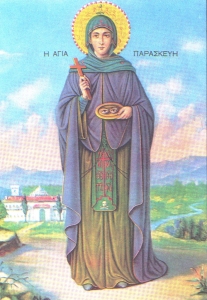
traditional depiction


     However, despite the enormous popularity, and even the cult respect and devotion this wonderful saint enjoys, she is oftentimes confused with at very least two other canonical saints, and a folk saint, which in fact might be a pagan Slavic deity in guise of a saint. Hence why I thought it might be a fine idea to write a little something about both the hagiographies of these saints, as well as share a few ideas on how could one work with them in terms of spiritual work. So let’s begging by comparing the history and the legends about their lives.

     St. Paraskevi the Parthenomartyr

     Also known colloquially as St. Paraskevi the Greek, and St. Paraskevi of Rome, this glorious virgin and martyr has lived and died in the 2nd century. She was a child of two pious Christians Agathonikos and Politea, and was born during the reign of Emperor Hadrian nearside the Rome. She was named “Paraskevi”, which in Greek literally translates to “preparation” ***, although it’s most often simply understood and translated as “Friday”.

     After receiving a rich education from both secular and theological sources, she grew up into a beautiful, knowledgeable and reportedly eloquent and inspiring young women. Losing parents when she was 20 years old, she sells all the fortune she inherits from her parents as a sole successor, and devotes herself to religious work and spreading the Word of G’d.

    Her work on converting people to Christianity, and her inspirational preaching have gained certain fame, so much so that they reached the Antoninus Pius ( ruled from 138 – 161 ) who was himself intrigued by her, and attracted to her wisdom and beauty. While he did not persecute Christians on the sole base of their religious choices, citizens could file a complaint against them, and in such case the given Christians would be put to trial. Which is what happened in the case of the St. Paraskevi. Refusing to offer sacrifices to pagan idols, she angered Antoninus Pius, and he puts her through several torturing episodes which she miraculously and stoically endures. These culminate in him ordering for her to be put in a cauldron filled with boiling oil and tar, and upon seeing her standing in the cauldron completely unharmed, he concludes she’s using witchcraft to cool down its contents. Reaching towards the cauldrons the hot fumes sear and blind him, causing him to cry out to the Saint asking for the help. The Saint promptly restores him to full health, returning his vision but only after stating, that it’s the Christian G’d who was healing him from the blindness received as a punishment.

    The Emperor releases St. Paraskevi, allows her to continue her missionary work and ends all prosecution against Christians throughout the Roman Empire.

    However after Anoninus’ death, Marco Aurelius replaces him, and he enforces laws which were much like the older ones, basically allowing merciless persecution of Christians and “non-believers”.

    Due to this St. Paraskevi ends up being arrested by a provincial eparch called Asclepius and thrown into a snake pit. Making a sing of Cross, she remains unharmed, in some version the snake is cut in half, in other it disappears into the thin air, while in another version it simply refuses to harm the Saint in any way. This leads Asclepius and his whole court to convert to Christianity.

    She is subsequently captured and convicted by another provincial eparch called Taracius, which after fruitlessly attempting to cook her in the cauldron of tar and oil (much like the Antoninus tried before), he orders a large stone to be put on her chest which she endures. In the following morning she’s taken willingly to the temple of Apollo to great joy of the pagan population, but upon entering the temple she raises her hand makes the sign of Cross, which results in loud noise and destruction of idols. Beaten, she’s expelled from the temple and Tarasius orders her beheading. Taken outside the town, as a last wish St. Paraskevi request a few moments for her prayers after which the solider execute her. [1]
     She’s commemorated on the 26th of July among the Orthodox Christians, and is considered a patron saint of the blind and those with eye afflictions and diseases. On some of the Icons, she’s depicted holding a vessel with water into which a reflection of two eyes is evident.
     According to the Orthodox Wiki;

     “Many healing miracles occurred as a result of St Paraskevi’s divine intervention. It is said that that merely coming in contact with (t)he dirt of her grave faithful, crippled could walk, demonized would return to health and that the infertile would bear children. Most importantly St Paraskevi healed the blindness of the roman emperor Antoninus Pius while she was in a heated cauldron. Her merciful disposition to her tormentor has made her an intercessor Saint for the healing of eye ailments” [2]

     One of the Holy places of pilgrimage is her tomb in Pounta in Greece, where, according to the local tradition ( near the river Acheron ) is the place she was actually beheaded. The legend speaks of her holding a large stone pillar when she was being beheaded, miraculously leaving a handprint in it.
     The pilgrims would reportedly cut off a piece of this stone pillar upon visiting the monastery, for talismanic purposes, which over the time caused the pillar to become half of its original size. [3]

     The miraculous skull of the Saint is kept in a monastery in Montastery Petraki in Athens, and is said to exude a myrrh-like substance even in modern days.
    
     St. Paraskevi the New

     St. Paraskevi the New, also known as; St. Paraskeve,  St. Paraskevi the Younger, and St. Paraskevi of the Balkans/Serbia/Romania/Bulgaria etc., is a Saint enjoying a cult devotion in Serbia, Romania, Macedonia, Croatia, Montenegro and some other places on the Balkan. The respect and veneration that this Saint, her holy relics, pilgrimage sites, and churches and monasteries receive comes not only from the Christians, but also from the Muslim population and the Hebrews, which makes the cult of St. Paraskevi ( “Sv. Petka” in Serbian, Bulgarian and Macedonian; from “Petak” which means “Friday” in the Serbian ) quite a cultural phenomenon too.
St. Paraskevi of Serbia
a common Serbian Icon depiction


     Parts of her life, personality and lore, are despite her enormous popularity still often confused with that of the St. Paraskevi the Parthenomartyr. Which is only understandable considering they do share many traits in common.

     She was a Christian martyr and ascetic nun, who was born and lived in the XI century Epivato, a village situated between Sillistra and Constantinople. She was born from pious, wealthy parents and would habitually go to church with her mother as a child. On one such occasions, it is said that the words of the Gospel;

     “If anyone would come after me, let him deny himself and take up his cross and follow me.”  ( Mark 8:34 ESV ) [4]

had such a strong impact on her, that she gave away all of her clothes to the poor and decided to seek out the ascetic, pious life. Upon the death of her parents she goes to the Constantinople and remains for 5 years in the church of the Most Holy Theotokos, in strict fast and praying. After that she goes to the Holy Land, wishing to experience and venerate the places where our Lord had walked and lived. After this she decides to spend some time in the desert across the river Jordan, where she has reportedly experienced apparitions of the Most Holy Virgin Mary and eventually an Angel who told her to go back to her birthplace, which she did. According to some hagiographies I’ve read, this happens when the St. Paraskevi was at the age of 25, and then she died two years after her return to the Epivato, which she had spent in strict and constant fast and prayer. According to other sources, she was “very old” when she left the desert, though she also lived for two years upon her return to the village where she was born, just like in the version which says she was 25 at that point. This is a rather peculiar discrepancy, and I personally have no idea as to why are there two versions about her life which seem to differ only in her age after her time in the desert.

     She was given a proper Christian burial, although not on the local graveyard, as it was a custom to separate the ascetics and theocracy from the common people in such cases. Many years afterward, according to lore, a sea washes out a pirate’s corpse ( in some version a local sailor dies, instead of a pirate being washed out by the sea ), and the people unknowingly bury him above the St. Paraskevi’s resting place, to which she protests by appearing in dreams of either a monk, or two different local people simultaneously, according to two different versions of hagiography. In the dream in which she appeared to a local men ( called George, and the women from the same place shares the same vision ) she’s seen as a beautifully embellished, enthroned Empress, followed by an army; she explains that she can’t stand the noxious scent of the body or a sinner rotting above her earthly remains, and explains who she is, and where exactly to look for her body. In the morning, the villagers, taught by this dream guidance, unearth her relics, find that they are incorruptible.
     Her miraculous relics have been moved a lot since then;

In 1238, the relics were transferred from Kallikrateia to Veliko Tarnovo, capital of the Second Bulgarian Empire.[9]
In 1393, they were transferred to Belgrade,[9] specifically the Ružica Church. When Belgrade fell to Ottoman forces in 1521, the relics were transferred to Constantinople. In 1641, the relics were transferred to Trei Ierarhi Monastery, in IaÅŸiMoldavia (nowadays, eastern part of Romania). In 1888, they were transferred to the Metropolitan Cathedral of IaÅŸi. “ [5]

     The relics remain in the Romanian town of Iasi to this day and are probably the most visited Holy Site of her devotees. Countless miraculous healings occur to the pious that come to pay respect to the Saint’s relics and pray for help.
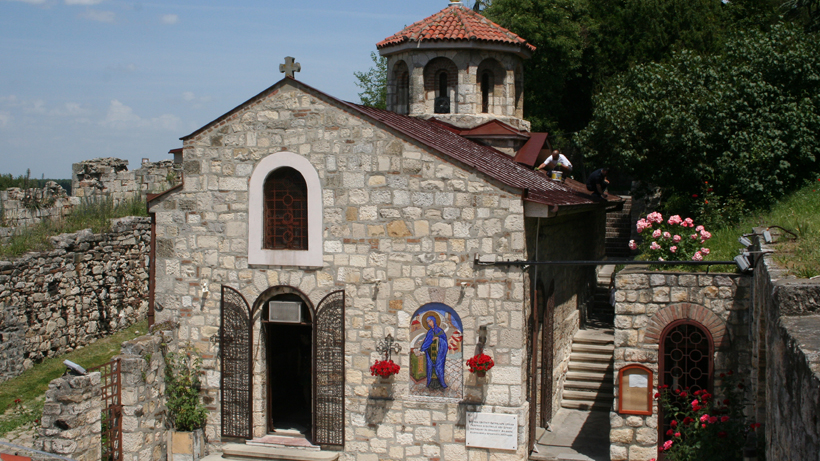
     Probably the second most visited place is the small church/chapel dedicated to her in the Belgrade, Serbia ( being a part of “Kalemegdan” fortress ), which also holds two fingers of the Saint as a relic and a wellspring containing water believed to provide miraculous healing even of the fatal diseases if collected with faith and respect.  The wellspring is Sacred to the Saint Paraskevi, and the water from it is often referred to locals and devotees as “agiasma”, and is believed to be particularly healing to any sort of eye condition or disease, including blindness.

The Church of St. Paraskevi in Belgrade, situated on the
"Kalemegdan" fortress

    
     St. Paraskevi of Iconium

     There is another St. Paraskevi, St. Paraskevi of Iconium who was martyred during the reign of Diocletian ( III century ) . Much like the previously described saints she was born to wealthy pious parents, and she was a martyr, and also a virgin. She was baptized on Friday, hence her name, but also because her parents were pious and named her that in the reverence of the day of Christ’s suffer. 

     In Russia, she’s a Patron saint of traders, fairs and of marriage, she’s depicted in red ( symbol of martyrdom ) on the icons, holding a Cross, scroll ( professing her faith ), and a perfume, sometimes she accompanies other saints ( like Saint Barbara, or Saint Anastasia for example ) , and is often referred to as “Pyatnica”. [6]

     “Petka” the folk saint

     In the rural areas of the Balkans there’s also a folk saint called Holy Friday ( in Serbian, Macedonian and Bulgarian called “Petka” ), although reportedly she’s also “venerated” in Russia. The Orthodox Church does not condone the reverence and rituals associated with this “saint”, and some councils have outright banned it ( the Sixteenth Stoglav council of Russia for example ), although it’s hard to reach the people in rural areas who take part in these rituals.

     The traits of this folk saint are rather similar to those of several Slavic deities, as are the ritual offerings and lore associated with it. Judika Illes hypothesized, it might actually be Slavic deity mokosh in a guise of Christian “saint”, which does make sense considering this spirit tabooed touching ground on her holidays, which are 12 Fridays throughout the year.  Also celebrations include a sort of frenetic behaviour, which include reckless singing, dancing and even intercourse. Not very “saintly” we can agree. Judika Illes describes this peculiar Friday observance in the following way:

Saint Paraskeva literally means Saint Friday and Friday is her holy day. Twelve Fridays spread    throughout the year are designated feast days when her devotees are forbidden to work. Each Friday spent not working provides protection from specific danger --- fire, floods and other hazards. Those honoring her twelve-day fast from work are allegedly guaranteed happiness, prosperity, and abundance” [7]

     She does share some traits in common with other St. Paraskevi, particularly the St. Paraskevi the New, and that’s her respect and love for cannon and rules, as one example. Also her signature all black clothes. However it’s possible that these are later additions by the Christian folk. Also her sacred sites are said to be wells and crossroads, and her feast days are on different dates in different areas ( sometimes coinciding with the 26th July, that is the feast day of the St. Paraskevi the Parthenomartyr ), although the “real” feast days are clearly these twelve Fridays. This could be further indicative that it’s a folk saint whose lore is a mixture of paganism and Christianity.

     Similarities, lore, folklore and spiritual work

     As you could probably notice, the tree Saints named Paraskevi ( minus the fourth, folk saint ) share certain common traits:
·         All three are virgins
·         Two of them are martyrs
·         All three had Christian parents
·         All three are named after a day of the week
·         At least two of them are invoked/prayed to for diseases of the eyes, frequently
·         All there have denied and/or sold worldly goods and pursued spiritual life
·         At least two of them are frequently petitioned for marriage

     Taking this in consideration it’s not hard to see why some facts about their lives frequently get confused. Or why people not particularly familiar with these Saint may think they are all one and the same.
     Further confusion may arise from the folk saint lore; as in Balkans the line between St. Paraskevi the New’s folklore and legend and that of this folk saint are oftentimes blurred. So one may hear how Paraskevi appeared in dreams of women to “initiate” them into magick, or has even repeatedly appeared in dreams to give “lessons” to women in magick, usually every now and then over a year period. These testimonies are oddly common in Southern Serbia ( particularly in the areas around the Timok river ), where St. Paraskevi is also seen ( unofficially ) as a patron Saint of female witchcraft. [8]
     In fact, if a women or girl, wanted to “study” witchcraft in Southern Serbia, it’s often advised she starts on the St. Paraskevi’s feast day ( 27th of October ) and pursues her skills and knowledge for a full year, that is until the next year’s St. Paraskevi’s feast day, when she “graduates” as it were. Needless to say, of course, such practices aren’t supported by the Orthodox Christian Church, and are seen as heretic or misguiding.

     Sometimes, in Serbia and Macedonia St. Paraskevi is considered a patron Saint against wolves and snakebites, while also said to sometimes punishes people by inflicting them with snakebites. Ironically she’s also invoked to heal snakebites. While some have speculated that this is the pre-Christian lore rubbing off on the Christian saint, it’s more likely that it’s actually result of confusion of St. Paraskevi the New with St. Paraskevi the Parthenomartyr, who was tossed in the snake pit but miraculously remained unharmed.

     St. Paraskevi the New is widely believed to rather frequently appear both in wake-time and in dreams to people, especially if they are about to, or have just committed a sin. She warns them, and teaches them how to mend their errs and helps them return to the right path. Testimonies of such are numerous among her devotes. She’s almost unanimously described as a women in black appearing and disappearing suddenly, infrequently to save a life. She appears to be very dogmatic, and in many of these testimonies warns people not to work on Holy days, be it a specific Christian Holiday or Sunday. The water associated with her, from a wellspring by the small Church dedicated to her in Belgrade, is widely hailed among Christians ( from various parts of the globe ) as a miraculous healing water, as long as it’s collected with respect and faith, particularly beneficial for eye-related conditions.

     To enlist the help of St. Paraskevi the New, people have:
·         prayed to the Saint in front of her relics asking for help
·         read the Akhatist of the saint in front of her relics
·         reading the Akhatist and the Paraclete in front of the Holy relics
·         left a diptych to be commemorated at Holy Liturgy
·         gave a diptych to the Church that has the Holy relics through another person visiting the Church
·         prayed to the saint at home [9]

     If you’d like to petition St. Paraskevi the New, and you can’t get to her relics, it’s fine. You can do so at home, or in a church dedicated to her. You can light a black ( like her clothes ) candle for her, if you’re praying at home, or a common, beeswax, church blessed candle. Particularly suited is a nice hymn composed by Nikolai Velimirovich, which can be used also as a means of thanking the Saint for help, which sometimes takes a form of straight out miracle!

 “The Lord desires a pure heart
Thus says the Gospel.
A pure virgin you remained,
And you gave your pure heart to God-
O most wonderful saint,
Saint Parasceva, our ideal!
The Lord seeks a most pure mind,
Without fancy and without falsehood;
And you presented Him your most pure mind,
Like that of an angel, of the same kind.
O most wonderful saint,
O Saint Parasceva, hearken to our petitions!
The Lord seeks a pure soul,
As a heavenly shrine;
You perfected such a soul,
And now shine in heaven.
O most wonderful saint,
Parasceva, help us!
By your prayers, help us
In the misfortunes of life.
Through the clouds of earthly sorrow
Bring us light, like a rainbow-
O chaste virgin, most wonderful,
Holy Mother Parasceva!
” [10]

     She’s petitioned for more than just eyes healing, she petitioned for finding lost items, finding a spouse, healing any persistent or seemingly hopeless condition, getting good grades and passing exams; to name a few common reasons to petition her.  I think it’d be very suited to petition her for guidance in your dreams.

     To petition St. Paraskevi the Parthenomartyr, you can add these Orthodox songs to her prior and/or after the heartfelt prayer:

Appropriate to your calling, O Champion Paraskevi, you worshipped with the readiness your name bears. For an abode you obtained faith, which is your namesake. Wherefore, you pour forth healing and intercede for our souls.  &
O most majestic One, we have discovered your temple to be a spiritual clinic wherein all the faithful resoundingly honor you, O famed and venerable martyr Paraskevi” [11] 


     To ask her to heal your or someone else’s eyes, you can try having some spring water in a vessel in front of her Icon, on an altar, so that it reflects her image, particularly her eyes. Light a blue, purple or olive green candle next to the vessel with water, and say your prayers and songs over it, then dip your fingers and dress your eyelids. As a sign of gratitude, you can donate to Christian Church, and you can help spread the faith to those interested in hearing about it. 

*"red letter" is a colloquial term for important Christian holidays, feast days and Sundays in the Christian church calendar around here. This comes from the fact that the most important Christian Holidays ( on which people usually fast, abstaining not just from food but oftentimes work ) are marked with red colour in calendars
** Slava is a custom of celebrating the feast day of the saint designated as a family Saint Protector/Patron in Serbia and Montenegro ( also some parts of Macedonia and Croatia though less frequently )
*** As the Friday is "preparation" for the Sabbath ( Saturday ) 

NOTE: This article was written and composed by myself, so if you wish to use any part of it elswhere online, feel free but add credits; Shadow of the Shadows magick place, Shadow-333@hotmail.com or a direct link to this post

CREDITS AND REFERENCES: REFFRENCES:
[3] Acc. to Spyros Mouselimis, article "The Monastery of Pountas and the Feast of Saint Paraskevi" 
[7] From: “The encyclopedia of mystics, saints and sages. A guide book to Asking for Protection, Wealth, Happiness, and Everything Else !” ( pg. 557th ) HarperCollins 2011th, first edition
[8] Several cases are described in the book “Cuda Vlaske magije” by Jasna Jojic Pavlovski
[9] As stated on ( and quoted here from ) : https://orthodoxwiki.org/Paraskeve_the_New
[10] Quoted from: http://www.pravoslavie.ru/english/print87153.htm ( access date October 2017th ), for educational purposes here, without any ill will.
[11] Quoted from the source listed under [2]

IMAGE CREDITS:

All used for illustrative and explanatory purposes without any ill will

Sep 30, 2015

St. Joseph of Cupertino , the flying patron of students and air-travelers

     St Jospeh of Cupertino (originally, in Italian; Giuseppe da Copertino) was born in 1603. ( June 17th ) in what was  back then, a kingdom of Naples. 
     
     It is said that he started experiencing ecstatic religious vision as early as in his childhood, which,
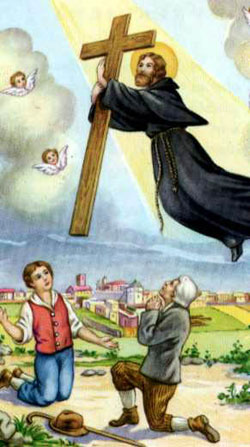
St. Joseph portrayed flying and
carrying a cross 
alongside his tendency to be airheaded, and act impulsive with outbursts of anger, made him very unpopular. He was scolded not only by people around him, because of this, but also by his mother. [1]
     
     After school he tried becoming a shoemaker, apprenticing with his uncle, but was not very talented for such. What he really wanted is a religious life, being very spiritual and religious ever since childhood, but inadequate education, and his likeliness to get things wrong, and forget about the chores assigned to him, caused his application to join Conventual Franciscan friars to be rejected ( 1620. ) as well as him to be dismissed after 6 months of service by Capuchin Monks near Taranto ( also 1620. ), and he was therefore, forced to go back to the scold of his mother. [2]

    Soon after returning home, he finally got accepted into Franciscan monastery, although to work as a stable boy, and care for the horses. He was said to have begun to change at that point, becoming better composed, and more serene, and his simplicity of life, piousness, and devotion have additionally impressed the monks so he was finally given chance to study for his priesthood. While he had more success with studies than ever before, they were still quite bothersome and a burden for him, but seems that Divine Providence wanted so that he become a priest. It is said that the examiner, conveniently, and accidentally picked the question, about which St. Joseph knew best, and in regards of which he was well versed, hence he finally became ordinated.     [3]

The Flying Monk

     Even after becoming a priest, St. Joseph of Cupertino was somewhat of an unorthodox, he was extremely pious, much like zealots, and is said to have eaten solid food once a day at best, fasted, and added bitter herbs to his soups such as Wormwood.

     He was more famed, or also notorious, at least among fellow monks, because of his miraculous levitation episodes. It would happen that during the mass he would get so deeply into prayer, that he would ecstatically levitate, often kneeling in the air, unresponsive to   pretty much anything, but his superior’s direct orders. The other monks would find his  sudden levitation disruptive, and some were even scared of them, because back then, such  supernatural abilities were deemed signs of demonic presence or involvement with dark magick and occult, and could have very well bring one before the Inquisition.

     According to the records, and lore and legends, the mere mention of G’d or spiritual matter, was often enough to set this saint off flying.  For example, on one occasion he levitated in the air during the singing of Christmas carols, soaring high in the air, before the altar, “knelling” in prayer, and on another occasion he  “ferried a cross thirty-six feet high through the air to the top of a Calvary group as easily as one might carry a straw” [4]  which is a scene often depicted in iconography related to him. He was popular and respect among the people, after many witnessed his miracles, and was often flocked and consulted for advices and help by them. He was said to have been   very devoted to Virgin Mary, and to have advised people to pray to her a lot, always having praiseful and inspiring words for her life and   work.

     He was beatified in 1753. and then sanctified 1763., ten years later.

Patronage, and Hoodoo spiritual work
    
     St. Joseph of Cupertino, was declared a patron saint of air travelers, pilots, exam takers and students, particularly poor students.

     However, he is seldom petitioned in Hoodoo, because the modern, marketers Hoodoo, wants us to believe that there is a list of Christian Saints which you can work with in Hoodoo, and which are Saints as recognized by Protestant Christian denomination. I for one, find this notion ludicrous, and misleading, being that Hoodoo was influenced by Catholic Christianity, at least originally, not Protestantism. 

     Nevertheless, many practitioners, including myself, preform spiritual work with Saints which are not on these Hoodoo lists, such as St. Cosmas and Damian   , or this Saint for example.

     Consequently the lack of information on how to “work” with these Saints appears, which is thankfully overcame by   testimonies and sharing of generous people who worked with these Saints, and their experiences become an invaluable sources.  That being said, before writing this article I looked this saint up in Anna Riva’s “Devotion to the Saints” and  Ray T. Malbrough’s “The Magical power of Saints”, and there was no entry on him.

     His feast day is 18th of September, and his herbs are Wormwood and bitter herbs, so You could mix Wormwood and Frankincense in an oil devoted to him, along with a piece of dry bread.

      An internet search yielded more results, which indicate how to work with this Saint in Hoodoo:
·         Purple or brown candles dressed with All Saints Oil are good  for working with him

·        *  His devotion places can be near the window, as he liked the outdoors
·        *  Offering of bread and fruits are fine, but as an  extremely humble Saint, he will truly cherish a  company, smile, belief in G’d, or some charity to those in need  
·         * A fine prayer to work with him can be this one:


O humble St-Joseph of Cupertino, singularly favoured by God, implore the Holy Spirit to enlighten my mind and strengthen my memory in the search of His Truth and Wisdom. May I succeed in offering God my finest work and may I grow in Knowledge, Understanding, Humility and Charity. May everything I learn in life be offered in faithful service to God, from whom flows that Wisdom which leads to eternal life. Amen.” [5]

     I’d presume that the best day to work with this Saint is Wednesday, and of course his Feast day, although, obviously, one can petition the Saint whenever the need arises.

Don’t forget it’s the Mercury retrograde time  be careful, vigilant and wise J If You need make a charm to protect You for its evil influences.
Many Blessings, Shadow

NOTES:  This article was written and composed by myself. If You wish to use any parts of it elswhere online, feel free but add credits  Shadow of Shadows magick place,  Shadow-333@hotmail.com  , or a direct link to this post

CREDITS AND REFERENCES: 

[1] According to the Wikipedia entry https://en.wikipedia.org/wiki/Joseph_of_Cupertino
[2] as under [1]
[3] According to the:
[4]  Cited from the source, which is listed under     [3]

[5] Courtesy of Miss Aura, a rootworker, who shared her experiences on working with St. Joseph of Cupertino on the following forum/message board http://forum.luckymojo.com/working-with-st-joseph-of-cupertino-questions-and-thanks-t19951s30.html

IMAGE CREDITS:  The image is from http://www.catholic.org/files/images/saints/72.jpg used here for illustrative purposes without any ill will
Jan 30, 2015

The Light of the World, and Candlemas

"All the darkness in the world cannot extinguish the light of a single candle"

St. Franics of Assisi, "The little flowers of St. Francis of Assisi "


     On the 2nd of February, Catholic Christians, and some Orthodox Christians as well ( along with Copts and Armenian Christians  ) celebrate the holiday commemorating the presentation of the 40 days old infant Jesus, our Lord, to the temple and purification of the Virgin Mary.

Presentation of Infant Lord Jesus , at the Temple
with Simeon and Ana, the Light of the World


     The holiday has varying names, in different Christian denominations, and different parts of the world, such as :  “The presentation of Jesus at the Temple”,  “Meeting” ( Greek Orthodox Church, originally; “Hyapapante” ), “Feast of Purification of the Virgin”, or as commonly called among the pious; “Candlemas”.

     Among Eastern Orthodox churches that use Julian calendar, Candlemas, often called “Meeting”, or “The Meeting”  is celebrated on 15th of February ( according to Gregorian   calendar ).
     For Pagans, the whole 3 day period, between 31st of   January and 2nd February ( sunset ) is a sacred period, called Imboloc, orOmeilc   ,  celebrating the lengthening of the days, arrival of the spring and the  conception of their chief solar, male deity, by a  goddess Brigid. They customary   offer this goddess  with milk, or butter during these days, and make special beds, that they “dress” ( pour on them ) with milk and honey.
     Christians, similarly, on 1st of  February, celebrate the Saint Brigit ( or St. Brigid, sometimes ) of Ireland, a saint reportedly brought up by the druids, but who had, even as a child, feel drawn by Christianity, and reportedly, after hearing  St. Patrick’s sermons, got baptized herself. She founded a group of monasteries in Kildare, she was famed for her   profound spirituality, and devotion, as well as charity. Legends speak of many miracles performed by St. Brigit, from the miraculous spreading of her veil, over the enormous   partition of certain King’s land, to rendering apple trees infertile, or wondrously fruit-bearing double fruits.  Her patronage is over: blacksmiths, Ireland, workers in dairy industry, babies, farmers, poor and needy,  children whose parents are not married, scholars, to name a few.
    
     The Holy Light of the world

     Candlemas, commemorates the presentation of the baby Christ, in the temple, as well as purification of the Virgin Mary, 40 days after the birth. This was a custom, or rather a ritual law, according to Mosaic laws, given to people by G’d over the prophet Messiah. According to Mosaic law, a mother who had given birth  to a “man-child”  was deemed unclean  for 7 days, and had to remain ( after these 7 days ), “in the blood of her purification” for the next 3 and 30 days ( so 33, plus 7, 40 altogether ). In given time period, the new mother, was forbidden  to  step foot in sanctuary,  or even touch holy things. After the given time period, she was to present her child in a temple, bringing with her, an offering, to be prayed over by the priest, in form of young ( one year old ) lamb; “for the holocaust”, and a “young pigeon or turtle  dove for sin”. If the mother was unable to provide a lamb,  the two pigeons or turtle doves, were used instead. Having the priest pray over these “sacrifices” the mother was rendered pure again. [1]
     In case of The most Holy Theotokos ( Virgin Mary ), and Jesus, the son of Lord, fulfillment of these laws was not needed, for the Virgin was pure ( regardless of what protestants try to argue, pointlessly I must add ), and the Lord knew His Only Son,  but  the Virgin and her Son, the Savior, have fulfilled the Mosaic law requirements regardless.
    St. Simeon the righteous, prayed over offerings of Virgin Mary, and then proceeded to relay to her a prophecy, about the destiny of Her Son, the Savior, as well as the sorrow she will feel one day for losing him. In the temple, at this point was also the Prophetess Ana, who immediately started offering prayers and praise to Lord for  Jesus, and speaking to everyone  about Jesus and his role in the  salvation and redemption of Israel.
    The scripture describes the event this way:

34And Simeon blessed them and said to Mary His mother, “Behold, this Child is appointed for the fall and rise of many in Israel, and for a sign to be opposed— 35and a sword will pierce even your own soul—to the end that thoughts from many hearts may be revealed.”
      36And there was a prophetess, Anna the daughter of Phanuel, of the tribe of Asher. She was advanced in years and had lived with her husband seven years after her marriage, 37and then as a widow to the age of eighty-four. She never left the temple, serving night and day with fastings and prayers. 38At that very moment she came up and began giving thanks to God, and continued to speak of Him to all those who were looking for the redemption of Jerusalem.” (Luke 2:34-38)  [2]

    Simeon, who had been promised that he will not see death, before he had seen the Savior of the human race, at that point, also said a prayer, which has later became known as “Nunc Dimmitis” ( or also, “The canticle of Simeon” ) and is as follows:
Latin:

Nunc dimittis servum tuum, Domine, secundum verbum tuum in pace:
Quia viderunt oculi mei salutare tuum
Quod parasti ante faciem omnium populorum:
Lumen ad revelationem gentium, et gloriam plebis tuae Israel.

English ( “Common worship” 2000. ):

“Now, Lord, you let your servant go in peace:
your word has been fulfilled.
My own eyes have seen the salvation
which you have prepared in the sight of every people;
A light to reveal you to the nations
and the glory of your people Israel.” [3]

     The same prayer is sung, as the blessed candles are distributed to the clergy and the pious, in the temple, during the Candlemas’ service ( mass ), by the choir.
     Adressing to the infant Jesus, as the light to the  revelation of Gentiles, Simeon affirmed that Lord Jesus, is The Light of the world, or the Holy Light of the world, of which we are reminded on Candlemas, and which is embodied in symbolism of blessed candles.
     This is also, why Candlemas, in Christianity, and Christian spiritual practices and  lore is a day of purification and illumination.

     Beliefs, lore and symbolism


     There are many beliefs associated with Candlemas, but some of the most beautiful and well recorded include those about the Blessed candles, Snowdrop flowers, and pancakes ( crepes ).


      Holy ( Blessed ) Candles

     It is a tradition to bless the candles, on Candlemas, both those from church and those brought from homes, by  the pious people, but it is required that the candles are made of beeswax.  This is really essential, being that it bears an important symbolism. Beeswax, created by bees, by collecting juices and nectar from the flowers, symbolized the  virginal, and pure flesh of the baby  Christ,  because he had not broken Virgin Mary’s purity, neither by conception, nor by birth. The candle’s flame, is symbolic of Light that illuminates the darkness of the world, which Lord Christ is. [4]
     According to the Saint Anslem of   Canterbury, there are three aspects of Blessed candle to observe, the wax, representing Lord Christ’s virginal body, the wick, representing His Soul , and the  flame, representing His Divinity. [5]
     The candles obtained at the mass on Candlemas, are considered particularly holy and powerful, and are this preserved by some   folk throughout the whole year (or as long as they last) and are lit in times of great need. Particularly when one needed to defend themselves from thunder, wolves or evil spirits. By merely lighting the wick, such candle was believed to dispel evil, banish and protect from storms and wolves, and all kind of enemies ( even humans ), or heal, but oftentimes,  the act of lighting and burning it was accompanied  by a prayer, such as the following:

Jesus Christ a King of Glory has come in Peace.+ God became man, + and the Word was made flesh.+ Christ was born of a Virgin.+ Christ suffered.+ Christ was crucified.+ Christ died.+ Christ rose from the dead.+ Christ ascended into Heaven.+ Christ conquers.+ Christ reigns.+ Christ commands.+

May Christ protect us from all storms and lightning. + Christ went through their midst in Peace, + and the Word was made Flesh.+ Christ is with us with Mary.+ Flee you enemy spirits because the Lion of the Generation of Juda, the Root David, has won.+ Holy God! + Holy Powerful God! + Holy Immortal God! + Have mercy on us. Amen
.  [6]

    Sometimes people will even divide the candle ( cut ) in pieces, and burn the whole pieces when needed.
    While it’s not exactly the same, You could bless Your own beeswax candle, and If done on Candlemas, obtain a powerful tool of magick, at least for apotropaic work. You can bless it, as it’s suggested to be done in Solomon’s key ( The Greater key of King Solomon, or “Clavicula Solomonis” ). If You are going to make it though, You will be needing a virginal beeswax  , that is the wax that the bees had laid for their first time. Otherwise, You can purchase a waxen candle from the Christian church.
    Then You’d proceed with saying the specific conjuration, reading a set of Psalms ( around 17 Psalms, I think ) and, finally a prayer:

I exorcise thee, O creature of wax (or of Earth), that through the holy name of God and his holy angels thou receive blessing, so that thou mayest be sanctified and blessed, and obtain the virtue which we desire, through the most holy name of ADONAI. Amen “  [7]

    By sprinkling the candle ( or  was You are going to use to make it ), You’d be done, that is according to The Greater Key of Solomon. I’d also cense ( fumigate ) with incense, as that’s what the Christian priests do with  the Candlemas candles. In fact the candles are being fumigated as they pray, specific five prayers. The Catholic priests have set of 5 prayers they use to bless these candles.
    If then, You’d wish to dress this candle, You have made Yourself, You could dress it with “Essence of light” oil formula, I composed ( see the formula bellow in the text ).
    There is also a prayer used for blessing the candles by Catholic Christians, and it goes as follows:

“Lord  Jesus,
You are the Light of the world:
we praise You,
and ask You to guide our steps each day.
Help us to love You and serve You faithfully,
and to carry our daily cross with You.

Bless + this candle,
and let it always remind us
that You are our Light in darkness,
our Protector in danger,
and our saving Lord at all times.

Lord Jesus,
we praise You and give You glory,
for You are Lord for ever and ever.

Amen.”  
[8]

     I am not certain, however, should this particular prayer be used only by the clergy  ( priests ) like in the case of those used for  creation of the Holy water, but it’s certainly befitting to be added, as a part of Your consecration ritual.

     Crepes

     While in Mexico, tamales and chocolate sauce are traditional food for Candlemas, and are prepared by person who found the coin ( or whatever was placed inside ) in the King’s bread on the feast of Epiphany  , in Europe it’s commonly the Crepes.
     This has also due to the belief that they stand for abundance, prosperity and wealth. There is even a belief in Europe, You should make and stalk Crepes, as the Church bells are sounded on mass some Sunday in January to ensure the prosperity through the year.
     On Candlemas, this belief would be befitting too. Fill the first crepe You make with  some Honey, roll it up, read Psalm 23 over it, and then eat it, so that You will never be hungry, but instead prosperous  in  the  upcoming month of the year.
     I use this amazing recipe for crepes    found on BBC’s website , and they always turn out amazingly.

     Our Lady of Sorrows / Softener of the Evil Hearts

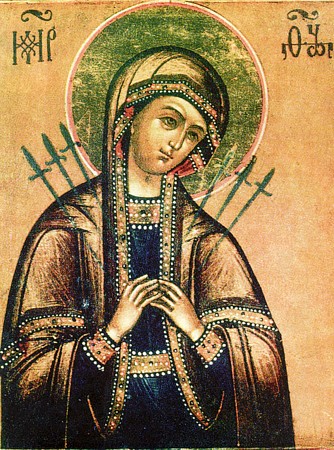
     Virgin Mary, is sometimes depicted with swords piercing her  heart, in accordance with St. Simeon’s prophecy. It’s reffered to as : “Our Lady of Sorrows” or “Our Lady who softens evil
Orthodox Christian icon, from Russia,
depicting Theotokos ( Virgin Mary )
with  swords piercing her heart; "Softener of
the evil hearts"
hearts”  ( in the Eastern Orthodox Christian   Church ).
     The latter, “Our Lady who softens evil hearts” , or “Softener of the evil hearts” or “Simeon’s prophecy”, is also the  Theotokos miraculous Russian icon, which is also commemorated  on the 2nd of February by Eastern Orthodox,  and some Eastern Catholics too.
     Among the Eastern Orthodox Christians, it’s customary to pray in front of it, to soften the hearts of our enemies, or even someone from whom we seek forgiveness, or even favors ( authority figures, teachers, bank clerks etc. ). Often the part
     If You wish to pray to the Mother Mary for such, in front of mentioned icon, light also a beeswax candle, and You can very lightly coat it with honey. Bellow it You can place a name paper with the name of the person whose  heart You wish softened, although this is not necessary. After a heartfelt prayer You may wish to add these words:
Rejoice, much-sorrowing Mother of God, turn our sorrows into joy and soften the hearts of evil men!”

     Snowdrops or the “Candlemas bells”

     The Snowdrop flowers,  are traditional symbols of Candlemas, in Europe, as they represent  hope, light and purity. They often bloom on Candlemas, even though that some varieties can bloom earlier, later or the whole winter, as a matter of fact. They are mentioned in apocryphal Christian legend, which speaks of how Eve was frightened and devastated because of the snow, she had encountered after the banishment, but was comforted by Angel, who had miraculously made the Snowdrops appear, in some version from the snowflakes, comforting Eve thus.
     While Snowdrops  are bad luck to take in home before the  Candlemas, brought into home on Candlemas they will bring purification, illumination and luck to home, and banish evil from it.
     The poem  “Origin of  the Snowdrop”  ( by George Wilson ) illustrates nicely the beliefs about snowdrops:

"And catching, as he gently spake,

A flake of falling snow
He breathed on it, and bade it take,
A form, and bud and blow;
And ere the flake had reached the earth,
Eve smiled upon the beauteous birth,
That seemed, amid the general dearth
Of living things, a greater prize
Than all her flowers in Paradise.

And thus the snowdrop, like the bow
That spans the cloudy sky,
Becomes a symbol whence we know
That brighter days are nigh;
That circling seasons, in a race
That knows no lagging, lingering pace,
Shall each the other nimbly chase,
Till Time’s departing final day
Sweep snowdrops and the world away
"

Retrieved from http://www.perilousadventures.net/blog/?p=1453 , for illustrative and explanatory purposes

Essence of light oil

My own formulae, suitable for use as a devotional oil on Candlemas, and in any spiritual work associated with illumination, purification and uncrossing.
Combine:

·         * Angelica roots
·         * Rosemary branch
·        *  Frankincense tears
·         * Chamomile flowers
·         * Calendula/Marigold flower

All in base of Sunflower and Jojoba mixed oil. Jojoba alone, Sunflower alone, and even Almond oil will work just fine.


Hope this was informative and inspirational for You
If I don’t post anything before it… Have a Blessed Candlemas
With luv… Shadow J


NOTES: This article was written, and composed by myself. If You wish to use any part of it elswhere online, feel free, but add  the  credits; Shadow of the Shadows magick place,  Shadow-333@hotmail.com or a direct link to  this  post 

CREDITS AND REFERENCES: 


[1] According to the Catholic Encyclopedia ( online ): http://www.newadvent.org/cathen/03245b.htm
[5] According to: “The Liturgical year” by Prosper Pascal Luis Gueranger (   abbot of Solesmes )
[6] Prayer retrieved from  the source listed under [4] , for educational, and illustrative purposes,no ill will
[7] Retrieved from: “They key of Solomon” S.L. MacGregor Mathers’ edition


Nov 13, 2014

The lore of Synaxis of Archangel Michael and other bodiless powers


Crop from Orthodox Christian icon Synaxis of Archangels 
The 21st November ( in Julian calendar, that some Orthodox Christian Churches still use, the date is marked as 8th of November ) in Orthodox Christian Church calendar is reserved for commemoration and celebrations of St Michael the Archangel and all other  angels. In Catholic Christianity this day is known simply as; Michaelmas, it’s celebrated on 29th of September,  and in European countries, it’s strangely tied to gooses, at least in folklore. It is a widespread Christian tradition (across the Europe at least) to catch a falling leaf, on this day,  while walking outside and make a wish.

St Michael the Archangel,  considered the Chief of Heavenly hosts, or the “chief commander of all the bodiless powers” [1] or Archistrategos (in Greek), is a well-known and popular archangel even to those that are not Christian. He is considered fiery, and terrifyingly powerful, but also extremely righteous and quick to help people in trouble, particularly life threatening situations. He is accounted for many miracles, some are documented in the Scripture.

Theologians think that the Angel appearing before Joshua  ( Joshua 5:13-14 )  was Michael, and that he was also the Angel who was helping Archangel Gabriel defeat the Persians, even though that Michael is not named in these instances.

The pillar of cloud ( by day ) or of fire ( by night ) that led Israelites from Egypt, during the Exodus, was in fact Archangel Michael, he is also considered to be the Angel who protected Three Holy Youths, Ananiah, Azariah and Misael ( Dan 3:22-25 ), and the one who transported the Habbakuk from Judea to Babylon to feed the prophet Daniel, while he  was in the lion’s den  (Dan. 14:33-37 ) .
Michael disputed with the De*il over the body of Moses, as we can see in the scripture

“Yet Michael the archangel, in contending with the devil, when he disputed about the body of Moses, dared not bring against him a reviling accusation, but said, “The Lord rebuke you!” “( Jude 1:9 ) [2]

There are also many appearances, and miracles of St Michael, that took place all over the planet, and were recorded outside of scripture. Perhaps the most famous is the Miracle of Collosae (Chonae )  commemorated in September. 

But on this day (November 21st ) all the Angels are commemorated and their deeds celebrated, and in Serbia and Montenegro, this is also a “feast day” ( Ser. “slava” ). And even though that the celebration of feast days in these parts of the world, was  closely tied to several traditions and rituals, among other, the baking of special cake, cooking a special wheat meal, and ritual drinking or spilling of vine, during the “Synaxis of Archangel Michael and other bodiless powers” , these rituals did not take place. For the Angels neither have body (symbolized by the cake) nor the blood (symbolized by the vine).

However Angels, particularly Seven Archangels, were propitiated on these days and favors were asked from them, prominently. Seven candles   were lit, each dedicated for one of the Seven Archangels, oftentimes each candle also being lit to represent particular wish. [3] I have provided the ritual, in details,  in another article of mine, on this blog, also dealing with Michelmas.

The very Archangel Michael was often petitioned on this day, alone, particularly in rituals and spells against evil, to cure a longstanding chronic disease, or remove a longstanding persistent curses and crossings, end persecution, for justice and so on.

Christians traditionally pray for salvation of the their souls from sin, or the souls of their beloved ones who had gone astray ( for example turned to drugs or alcohol, gambling, or any kind of addiction or sinful lifestyle ) , for the Christians firmly believe that Michael will intervene and save them from sin, and guide them back to the path of righteousness. Among the Orthodox Christians he is often referred to as “Soul-saver” ( Serb. “dusovadnik” )  for this particular reason. 

The folk tradition insists that Michael must be “paid” for his services, and that in fact, after saying
Monastery of St. Michael the Archangel, Panormitis,
Dodecanese, Greece 
prayers to him  one is to promise some kind of token of gratitude, be it giving alms, lighting a candle in the Church for him, or leaving a broom as a present to him.  According to same tradition, the promise given to the Michel must be fulfilled, or else, the Saint will get angry and oftentimes even  openly show it through miraculous acts and appearances. According to the reports of pilgrims and local people, on the small isle of Symi in Dodecanese ( Greece ) :

The Archangel Michael is famous in the Dodecanese for his righteous nature. If you have made an offering to him and did not fulfill it, he will make it clear through various miracles that he is not pleased - until you complete your promise. One famous miracle that occurs often and to this day, is the miracle of the Archangel preventing the boats from leaving the dock. This has become such a regular occurrence, that the Captains of the boat will announce over the PA to the passengers that someone on the boat has forgotten a promise to the Taxiarch. Once this promise is fulfilled, then and only then does the boat's engines work.[4]

Taxiarch, is a Greek phrase for “Archangel”

Following are a few ideas for working with archangel Michael and other archangels and angels suitable for this day

Prayer in a bottle

Another Greek Orthodox Christian tradition, originating from the Dodecanese region.
Write down Your petition on a piece of paper and place it  in a bottle. If You are afraid that someone could find, and read it, You can  sign the petition with initials and date of birth, or add a personal concern of some kind to it. Pray to St. Michael for Your need, and promise something in return. Close the bottle tightly and place it into body of water, ideally into sea/ocean.
Fulfill your promise.

Celestial help, Angel invocation ritual

This ritual is best suited for Michelmas, though it can really be done anytime the need arises. However, this ritual should not be done for trivial things, or to fulfill our whims, instead the ritual should be done when there is objective or urgent need for help, or guidance. At least for a day before preforming the ritual fast, and abstain from intercourse. Also, if possible, take a cleansing bath prior to the ritual.

Place some metal objects (coins will do) in a larger white handkerchief, and tie the ends so that You get a nice, roomy pouch. Tie the ends with three knots. Alternatively, You can use a (previously properly cleansed) small bell.

Make some meringue cookies yourself. They should contain only sugar and egg white, though You can add cream of tartar, or salt so that they turn out nice. You will need four for the ritual.
Set four white or beeswax candles on four corners of the table, and next to each place a single meringue cake. Light the candles.
Ring the bell, or clank the coins tied in handkerchief. Some people do it on four  cardinal directions, others ring three times and so on.

State your petition, invoke angels to help and aid You with it. You can use something like this to invoke the aid of angels:

Angeli vos invoco, in hoc loco, in hoc tempore. Liberate me ab omnium malorum, adjuvate me, custodte et gubernate. Angeli, vos imploro, exaudite orationem meum! In Nomine Dei Patris, Dei Filii et Dei Spiritus Sancti! Amen!

( Hope my Latin was good there ) Once again ring the bell/clang the coins. Let the candles burn themselves out.

Instead of stating the petition, some people write it down on a piece of paper and leave it on the table, under a glass of water that they place in the center. Either way, remember You are not evoking angels, most likely You won’t actually see them, but You might experience all sort of “paranormal” phenomena.

Uriel’s Divination

Following is a peculiar little ritual I have found in a local occult magazine and translated for posting here. What the ritual is supposed to do is to invoke the Archangel Uriel, to give answers to questions. Basically, it’s higher magick type divination. The ritual is following:
Cover the altar or table with a white cloth. Place in the center a glass of pure, clean spring water that has not been used for anything else. Left and right from the glass, place and lit a white candle  ( so two candles altogether ) .  Sit, and in front of the glass, place a metal coin or metal disc that has Cross engraved* upon it. Dip the three prayer fingers ( thumb, pointer and middle finger connected with tops ) into the glass with water, and then sprinkle some of it onto the disc/coin, while saying:

Benedicto Dei Patris Omnipotens super vos, et maneat semper!”

Place the coin/disc underneath the glass, then kneeling in front of the table say the following:

All Holy Angels, White Angel, my good angel guardian, I pray to You all to remove anything that can prevent Uriel to show me what I wish to see and find out in whole truth, as it is truth, as it is true that G’d had sent You to be my guardians. In gratitude, I will read “Our Father” !”

Read/say  “Our Father” and then proceed with following text:

Holy Uriel, I beseech You, by the Living G’d, Who IS Your Lord as He  IS  also mine, with virginity and purity of St John the Baptist, and with virginity and purity I give to You through the staff of Moses, to come to this glass of water and remain there until You have responded to all the questions I will ask You. Ghalat, Ghalata, Kalin, Kala. Welcome, bring the Book of Moses with You, open it, put Your hand on it and swear to me that You will enable me to see, what I wish to see, and I will read  Our Father to Jesus Christ,  and Hail Mary to Virgin Mary.

When You start seeing something in the glass, say the following:

Holy Uriel, I beseech You by the Living G’d ; to show me what I will ask form You, I will read Our father and Hail Mary.

When You have gotten Your answer/s from  the Angel, release the angel saying these words:

Ite at pace, ad loca vostra, sit pax inter nos and vos” [5]

And that’s it. Does not really  seem to have a lot of merit J but it’s worth of trying, I guess.  If by any chance, You happen to know the source of this ritual ( I’m very curious about it ), please post in the comments bellow, or mail me.
Hope this post was interesting and that You have maybe learnt something new.
Blessings and luv
Shade 

NOTES: This article was written and composed by myself , If You wish to use it elsewhere online, feel free, but add credits: Shadow of Shadows magick place, Shadow-333@hotmail.com or a direct link to this post
*Allegedly the ritual dates back to Middleage, when a coin of 5 centimes that had Cross engraved on it was used. I don’t even know if such coin ever existed, but either way any round plate or metal disc with Cross will work. St Benedict’s Medallion for example.
CREDITS AND REFRENCES:
[2] Retrieved from: https://www.biblegateway.com/passage/?search=Jude+1%3A9&version=NKJV for educational purposes, without ill will
[3] According to “Kalendar za srecne dane” ( lit. Lucky days Calendar ) by Jasna Jojic Pavlovski, more about the book here http://jasnajojic.com/category/odlomci-iz-knjiga/kalendar-za-srecne-dane/
[4] Retrieved form: http://orthodoxwiki.org/Archangel_Michael_of_Panormitis , used here for illustrative and explanatory purposes
[5] Original text ( in Serbian )  found in “Bakini recepti za srecu I zdravlje” #18, 5th March 2013., more about the magazine here: http://www.lekiamajlija.com/?cat=462 
IMAGE CREDITS: The first image is from :     http://www.orthodoxarkansas.com/wp-content/uploads/Synaxis-Archangels-cropped-300x234.jpg used here for illustrative purposes without any ill will.  The second image is from:  http://www.panoramio.com/photo/53001209  and is used here for illustrative and explanatory purposes, without any ill will