February is crawling upon us, this year having an extra day too. It’s
a month when we celebrate the “Imbolc” or “Candlemas” , and it’s a month that
is thought to precede the arrival of the spring, and announces it, in spiritual
thought. Indeed, for those parts of the planet that are blessed with seasons (
lol ), it does mark a period of more fair, if a bit moody weather. It already “smells”
like spring where I am. The Snowbells are probably out already too, and soon
the Saffron flowers, Buttercups and Daisies will follow, if this weather keeps
up.
Therefore, it’s
hardly a surprise that the many civilizations and cultures associate it with
the arrival of the spring and the end of the “dark” part of the year. The day lengthens,
and people divine weather by signs. Make Imbolc Maiden beds, and do rituals to
chase away the bad luck, and misfortune and replace it with the good luck. In
thoughts of some civilization, it’s pretty much the actual New Year’s
celebration. A good example is the Setsubun, a day that marks the begging of
the spring in Japan.
Setsubun
significance and rituals
Setsubun is a religious and public holiday (although not a national holiday) in Japan, commemorating seasonal division, and the begging of the spring, modeling after “Tsuina” an older Chinese custom that influenced the Setsubun rituals and customs. [1]
 |
| Oni Demon face/mask is a popular tattoo design, here with a blue face, but equally often with red . Oni demons are the ones being banished with the Mamemaki ritual |
It’s celebrated on
the 3rd or 4th of
the February, the day before the start of the spring, according to Lunar
calendar of Japan. Some of the customs and celebrations date back to the 13th
century [2]
The festivities
include dancing, singing, throwing roasted soy beans, money inside envelopes,
candy, treats, glitter, and religious ritual intended to deter and banish evil
spirits, and draw fortune. The last is associated with the belief that, much
like in the case of the European Samhain, or Midsummer, the veils between the
worlds are thin on this day. Another example of similar notion taking important
part of the holiday lore, is the Chinese
ghost month, of the Hungry Ghost month . And the other important lore of the
Setsubun is focused on drawing the fortune. Hence the rituals with throwing
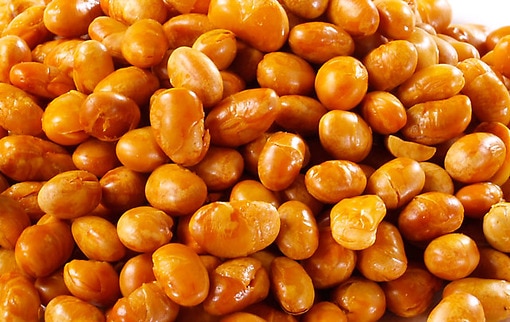
lucky and auspicious things, namely “fuku mame” ( lit. “lucky beans” ) , which
are roasted soybeans, or in some parts of Japan peanuts, although the latter is
much less frequently used. So in that sense, Setsubun in much of a New year
type of spiritual time, and is ideal for
cutting ties with the misfortune, disease, and damaging, and replacing it with
health, fortune and helpful.
Traditional Sake
with ginger is drank during this festival, and some of the roasted soybeans are
eaten, traditionally the number of beans eaten corresponds the number of the
age of person, or the number of the age of person plus one for luck. The bean
throwing ritual, also known as “Mamemaki” can be performed in the temples, at
the public ceremonies, or at homes in the family circle, or both. It’s
customary for people to get together on this day and often the celebrities and sumo-wrestlers
are invited to take part in public celebrations.
Sardine heads for
protection
Sardine heads are
a peculiar choice of an amulet, by Japanese people, hung on the doors alongside
the branches of Holly, tied with a knotted rope on Setsubun, so that they deter
the evil spirits from entering the premises. Sometimes soybean husks are hung
alongside the fish head. In some more archaic rituals, the sardine heads, well
dry, and old wood were burnt, and smoke was wafted to chase away the evil
spirits, often accompanied by sounds of drums. Although archaic, these types of
rituals are still practiced today in some parts. [3]
The Mamemaki
ritual
 |
| Roasted soybeans as used in the Mamemaki ritual. They serve both for throwing outside or on person wearing an Oni mask, and to be eaten for attracting the good fortune/luck |
This ritual is
done, to repel the Oni demons, a blue or red-headed troll like creatures from
Shintoism lore, believed to bring diseases, misfortune and other bad things to
people. Reportedly, the soybeans, while raw hard, and pretty much inedible, by
being processed by fire become edible and symbolize thus the conquering of
hard, dangerous Oni demons. In that sense, the ritual of throwing and then
eating the beans, is like the fire which softens them. Thrown at the demons,
they are symbols of their defeat. So there’s a bit of sympathetic magick in the rite. Also, all
beans are considered lucky in Japanese folklore, hence the inclusion of such in
a ritual that both repels and drives away evil.
The very ritual is typically described in the
following manner:
“On Setsubun,
each household loads up asakemasu, the wooden box in which sake is
sometimes served, with roasted daizu, or soybeans. Then the head of
the household (or a male in the household whose Chinese zodiac animal matches
that particular year) throws handfuls of beans outside of the front entrance
while chanting, “Oni wa soto, fuku wa uchi” (“Demons outside, good luck
inside”).
Sometimes the
rest of the household chants along, “Gomottomo, gomottomo” (“That’s
right, that’s right”) as he performs this task; some, especially the kids, play
the part of oni by donning paper masks and running from the bean-thrower. This
ritual is called mamemaki, or the scattering of beans. Afterward,
everyone eats the same number of roasted beans as their age for luck.” [4]
So we see that the beans are thrown either
around the houses, temples, or at the person/people wearing the Oni masks. The
last is a typical roleplay ritual, not completely unlike those performed by
Wiccans for example. Sometimes these beans are thrown vigorously through the
open door, the phrases is spoken/yelled and then the doors are violently and
swiftly shut close. This is a practice common for many spirit banishing spells,
or spells and rituals that symbolize cutting ties with something bad.
As an interesting side note; a somewhat comparable
ritual with beans, was done during the Roman Saturnalia ( Sol Invictus ) , for the similar purpose, only that the
ancient Romans were driving away the evil spirits of the dead, known as Larvae
and Lemuri. Incidentally, or not, this was also a celebration which is
similarly considered a New Year’s celebration festivity.
Ehoumaki, the huge lucky sushi roll
Another, more popular and urban tradition
associated with the Setsubun holiday in Japan, is eating the fas sushi roll ( “futomaki”
) which contains 7 ingredients, on this day and it’s called “Ehoumaki” ( Ehou
being pronounced much like the “echo” ) and must be ate facing a specific lucky
direction.
The ehoumaki may be purchased in the
stores, as they are readily available in
time of the holiday but there are some requirements that must be met in order
for it to work it’s lucky charm; it must contain seven ingredients, if possible
ones reputed to be lucky, it must not ( under any circumstances ) be cut, and
it must be ate in silence, facing a specific lucky direction which changes from
year to year. [5]
Don’t forget that
about Imbolc/Candlemas and Valentine’s Day , which are also in February.
Lots of love and
many Blessings
Shadow
NOTES: This article was written and composed by myself, so
If You wish to use any parts of it elsewhere online feel free, but do add credits;
Shadow of the Shadows magick place, or Shadow-333@hotmail.com or a direct
link to this post
CREDITS AND REFERENCES:
[1] Acc. to https://en.wikipedia.org/wiki/Setsubun
[2] Acc. to http://www.japan-guide.com/e/e2285.html
[3] Acc. to the source listed under [2]
[4] Retrieved from: https://japanesemythology.wordpress.com/banishing-demons-one-bean-at-a-time/
for educational, informative and explanatory purposes, without any ill will
[5] Acc. to http://justhungry.com/ehou-maki-lucky-long-sushi-roll-setsubun-no-hi
, also recipes for ehoumaki provided there
IMAGE CREDITS: Roasted soy nuts; https://nuts.com/images/auto/510x340/assets/fad12b4fdbcc34d3.jpg
Oni demon face/mask tattoo design http://www.tattoobite.com/wp-content/uploads/2014/05/blue-oni-mask-and-waves-tattoo-design.jpg Both used here for illustrative and explanatory
purposes without any ill will